
AgTech Funding in Europe: Which Grants Fit Your Stage in 2026 and 2027
Agtech funding is the money a company raises to develop agricultural technology, such as field robots, crop sensors, biologicals or farm software. In Europe, the public share comes from four sources: EU grants, German federal grants, the Forschungszulage tax credit, and promotional loans or public equity.

Summary
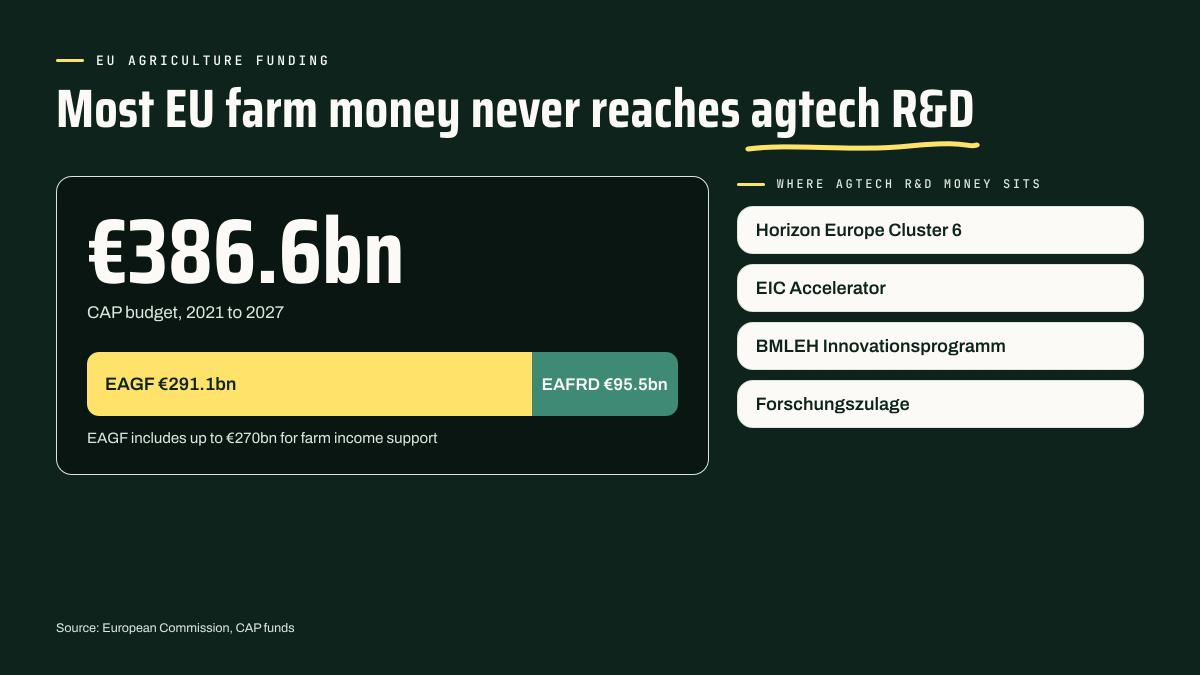
- Most of the EU's €386.6 billion farm budget for 2021 to 2027 is income support for farmers.
- The EIC Accelerator funds single companies at TRL 6 or above with a grant below €2.5 million.
- Horizon Europe Cluster 6 needs a three-country consortium. Its next first-stage deadline is 8 April 2027.
- The Forschungszulage covers farms and agtech companies and can run next to a grant, but never on the same costs.
Agtech funding is the money a company raises to develop agricultural technology, such as field robots, crop sensors, biologicals or farm software. In Europe, the public share comes from four sources: EU grants, German federal grants, the Forschungszulage tax credit, and promotional loans or public equity.
The EU's largest farm budget mostly pays farmers rather than the companies building their tools. This guide shows which programmes fund agtech R&D in 2026 and 2027, what each pays and when to apply.
What does agtech funding in Europe actually cover?
Agtech funding in Europe covers four kinds of public money for developing agricultural technology: grants, tax credits, promotional loans and public equity. Each pays for a different stage and sets its own rules on who can apply, so your technology readiness level (TRL) and company type decide where to start.
- EU grants: Horizon Europe Cluster 6, the European Innovation Council (EIC) Accelerator and EIP-AGRI Operational Groups
- German grants: the BMLEH Innovationsprogramm and calls from the Federal Office for Agriculture and Food (BLE)
- Tax credit: the Forschungszulage, Germany's research allowance
- Loans and equity: Rentenbank start-up loans, the EIC Fund and EIT Food investment
Grants fund a defined project and open on fixed call dates. The Forschungszulage works through the tax system, so there is no call to wait for.
Why most EU agriculture funding never reaches agtech developers
Most EU agriculture funding supports farm incomes and rural areas, so little of it becomes agtech funding for companies developing a product.
The Common Agricultural Policy (CAP), the EU's farm budget, totals €386.6 billion for 2021 to 2027, according to the European Commission. The European Agricultural Guarantee Fund (EAGF) holds €291.1 billion of that, with up to €270 billion for income support. The European Agricultural Fund for Rural Development (EAFRD) holds €95.5 billion. Because income support is budgeted to 2027, farmers keep receiving CAP payments in 2026.
The CAP's innovation strand is the EIP-AGRI Operational Group, a project team of farmers, advisers, researchers and companies testing a practical innovation. Germany runs these groups through its federal states, and in Schleswig-Holstein each group can receive up to €500,000 in funding. Farms, advisers and non-commercial institutions get 100%, while SMEs and commercial research institutions get 50%. The last call there closed in July 2025.
An Operational Group therefore suits field testing with farm partners. Core product development needs another route.
| Who receives it | Open to agtech developers? | |
|---|---|---|
| CAP income support (EAGF) | Farmers | No |
| CAP rural development (EAFRD) | Farms, rural actors, Operational Groups | Indirectly, as a group member |
| EU R&D programmes (Horizon Europe, EIC) | Consortia and single SMEs | Yes |
| German R&D funding (BMLEH, Forschungszulage) | Companies and farms in Germany | Yes |
Sources: European Commission; EIP-Agrar Schleswig-Holstein; EIC; BMLEH Innovationsprogramm; FZulG; checked 21 October 2026.
Which EU agritech grants fund R&D in 2026 and 2027?
Four EU agritech grant and investment routes fund R&D in 2026 and 2027: Horizon Europe Cluster 6, the EIC Accelerator, EIP-AGRI Operational Groups and EIT Food investment. They differ in whether you need partners and how mature your technology must be.
Horizon Europe is the EU's research and innovation programme for 2021 to 2027, and Cluster 6 is its strand for food, bioeconomy, agriculture and the environment. EIT Food, the agri-food community of the European Institute of Innovation and Technology, invests up to €1.5 million in equity in start-ups from its own programmes.
| Who applies | What it pays | Next date | |
|---|---|---|---|
| Horizon Europe Cluster 6 | Consortium, 3+ countries | 100% (RIA) or 70% (IA) | First stage 8 Apr 2027 |
| EIC Accelerator | Single start-up or SME | Grant below €2.5m, equity €1m to €10m | Cut-off 4 Nov 2026 |
| EIP-AGRI Operational Groups | Farm-led groups with companies | Up to €500,000 per group (Schleswig-Holstein) | Set by each federal state |
| EIT Food investment | EIT Food programme start-ups | Equity up to €1.5m | Through EIT Food programmes |
Sources: Cluster 6 work programme; European Innovation Council; EIP-Agrar Schleswig-Holstein; EIT Food; checked 21 October 2026.
The agtech funding dates below run from November 2026 to September 2027:
| Programme | What happens | |
|---|---|---|
| 4 Nov 2026 | EIC Accelerator | Last cut-off of 2026 |
| 19 Nov 2026 | EIC | Info day on 2027 opportunities |
| 1 Dec 2026, 12:00 | BLE robotics call | Project sketch deadline |
| 13 to 14 Jan 2027 | Horizon Europe Cluster 6 | Info days, brokerage event 15 Jan |
| 4 Feb 2027 | Cluster 6 two-stage calls | Calls open |
| 8 Apr 2027 | Cluster 6 two-stage calls | First-stage deadline |
| 22 Sep 2027 | Cluster 6 single-stage calls | Deadline, calls open 20 Apr |
Sources: EIC; BLE; Cluster 6 work programme; checked 21 October 2026.
Consortia for the April 2027 first stage are forming now. A partner search started in January leaves about three months for the short proposal.
How Horizon Europe Cluster 6 works for agtech companies
Horizon Europe Cluster 6 funds collaborative projects, so an agtech company joins a consortium as one partner. According to the Bavarian Research Alliance (BayFOR), a consortium needs at least three independent organisations from three different EU Member States or Associated Countries. At least one must be in a Member State.
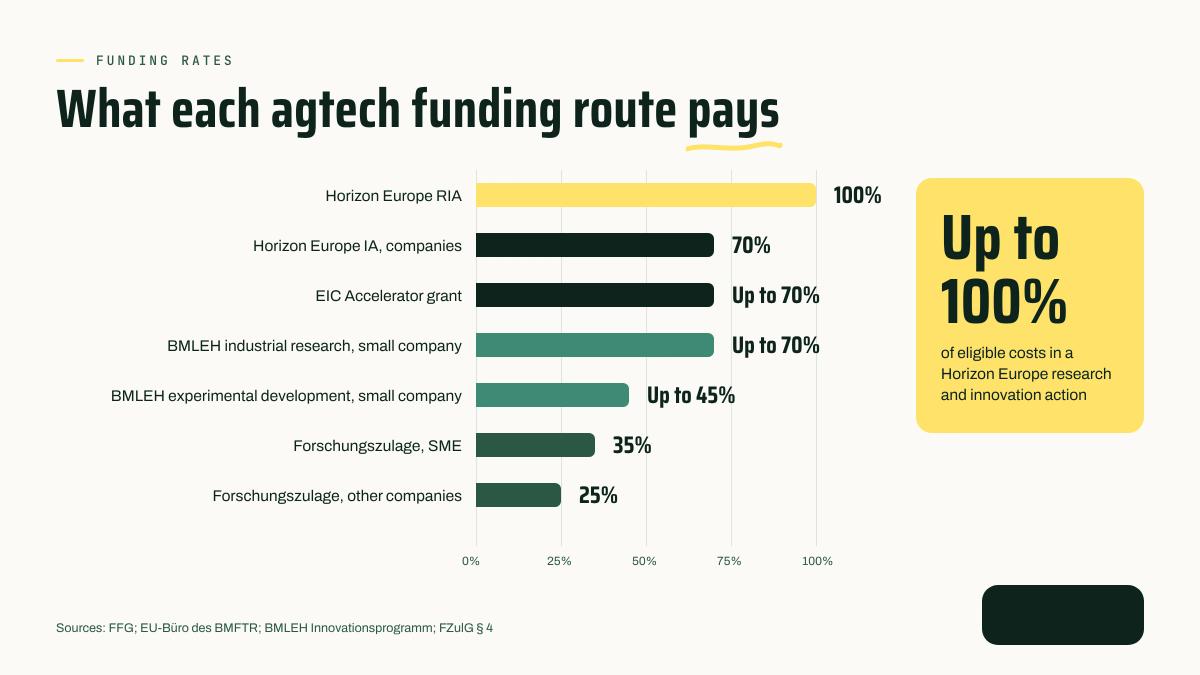
The funding rate depends on the action type. A Research and Innovation Action (RIA) pays 100% of eligible costs, according to Austria's national funding agency FFG. An Innovation Action (IA), aimed at demonstration closer to market, pays companies 70% and non-profits 100%. Indirect costs add 25% of direct costs.
The 2027 Cluster 6 calls include two-stage calls: a short proposal first, then a full proposal if invited. The Commission's Cluster 6 work programme (PDF) lists the 2027 two-stage call as opening on 4 February 2027. Stage one is due on 8 April and stage two on 16 September 2027. Our explainer on the Horizon Europe structure and its clusters shows where Cluster 6 sits.
A Cluster 6 proposal starts with fit, which is where our Horizon Europe funding consulting begins. We match your project to a 2027 topic and action type, write the technical and impact case, and submit it through the EU Funding & Tenders Portal in your name. The fee is agreed in advance.
Is the EIC Accelerator right for a single agtech company?
The European Innovation Council (EIC) Accelerator, the EU's grant-plus-equity instrument for single start-ups and SMEs, fits an agtech company that wants EU funding without a consortium. It requires TRL 6, meaning the technology has been demonstrated in a relevant environment.
The EIC Accelerator pays a lump-sum grant below €2.5 million for work at TRL 6 to 8, and the EIC Fund can add €1 million to €10 million in equity. The grant covers up to 70% of eligible costs, according to the German national contact point at the BMFTR's EU-Büro. The remaining 30% needs other financing, as our EIC Accelerator case in deeptech hardware shows.
Agriculture has its own 2026 EIC Challenge. The EIC notes that about 60% of EU soils are considered unhealthy. Its "Biotech for Regenerating Agricultural Soils" Challenge funds bioremediation, soil and microbiome management, renewable fertilisers and biostimulants. Every proposal needs a life-cycle assessment (LCA), which measures environmental impact from raw material to disposal.
Agtech companies do win. Elicit Plant, a French SME, received an EU contribution of €2,500,000 through EIC Accelerator blended finance, against a total project cost of €9,854,062.50, according to CORDIS. Its phytosterol-based product is authorised in France for corn and soybean. In June 2026, the EIC selected 38 of the 87 companies it interviewed, including Amatera Biosciences, whose CellTera platform automates single-cell regeneration for crop genetics.
Cut-off dates and application steps are in our guide to the EIC Accelerator grant and equity rules.
German agtech grants from BMLEH, BLE and Rentenbank
Companies with an establishment in Germany have three national routes to agtech funding: the BMLEH Innovationsprogramm, BLE calls and Rentenbank start-up loans. The BMLEH is Germany's federal agriculture ministry (Bundesministerium für Landwirtschaft, Ernährung und Heimat), and the Federal Office for Agriculture and Food (BLE) runs its Innovationsprogramm.
The Innovationsprogramm pays by company size and type of work. Small companies can receive up to 70% of eligible costs for industrial research, which the programme maps to TRL 2 to 4. Projects need substantial business participation, and applications start with a project sketch (Projektskizze).
| Industrial research (TRL 2 to 4) | Experimental development (TRL 5 to 8) | |
|---|---|---|
| Small company | Up to 70% | Up to 45% |
| Medium-sized company | Up to 60% | Up to 35% |
| Large company | Up to 50% | Up to 25% |
| Research institution | Up to 100% | Up to 100% |
Source: BMLEH Innovationsprogramm, Fördervoraussetzungen und Förderquoten; checked 21 October 2026.
The current BLE call seeks AI-supported robotics and automation in agriculture, developed jointly by companies, research institutions and farms. Project sketches are due by 1 December 2026, 12:00, through the easy-Online portal.
The Landwirtschaftliche Rentenbank, the federal promotional bank for agriculture, runs a federal fund for agri-related start-ups. It lends up to €800,000, or €1 million in justified cases, over 2 to 10 years as a subordinated loan, which ranks behind other creditors. A separate grant covers up to 90% of eligible advisory costs, capped at 15% of the loan and €50,000. Applicants must be small enterprises in Germany, no more than five years old.
For biologicals, the research ministry BMFTR's KMU-innovativ programme for SMEs has a Bioökonomie call covering plant breeding and plant health.
How the Forschungszulage works for agtech companies and farms
The Forschungszulage, Germany's research allowance, is a tax credit on eligible R&D costs, and farms qualify as well as companies. Section 1 of the Forschungszulagengesetz (FZulG) covers taxpayers with income from agriculture and forestry, alongside trade and self-employed income.
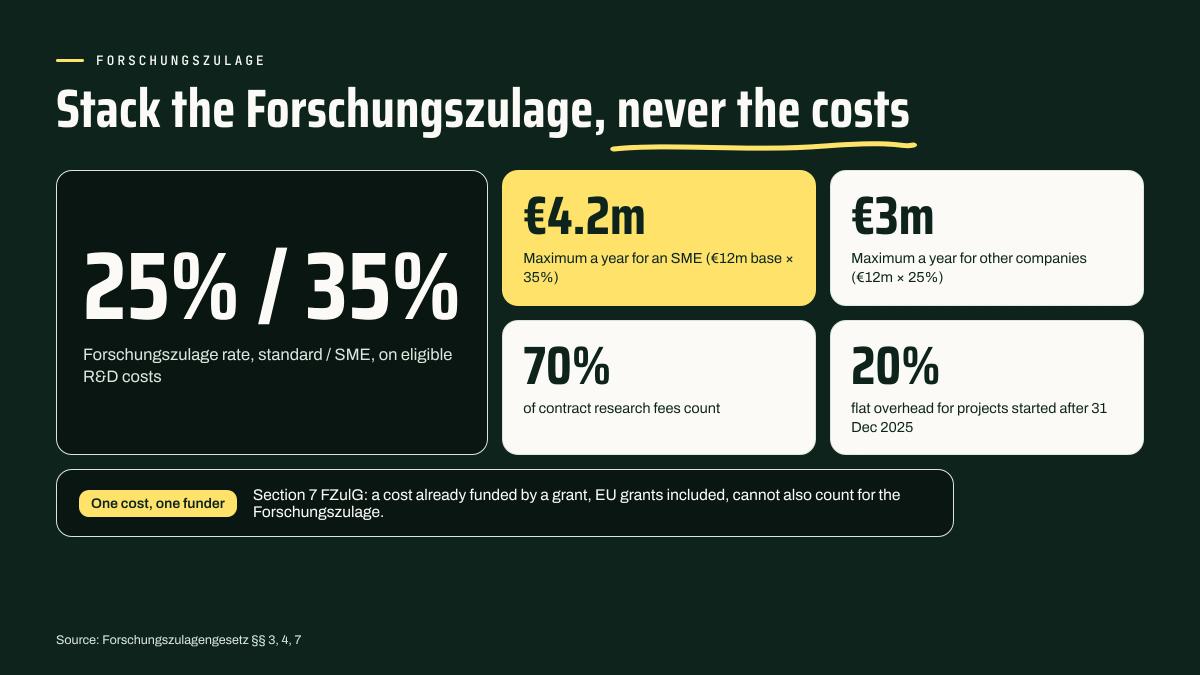
Under Section 4 FZulG, the allowance pays 25% of eligible costs, or 35% for SMEs. For expenses after 31 December 2025, Section 3 caps the eligible base at €12 million a year. The Bescheinigungsstelle Forschungszulage (BSFZ) must first certify the project as R&D.
Section 3 also sets the cost rules for field and lab work:
- Contract research: 70% of the fee counts for contracts placed after 27 March 2024.
- Equipment: depreciation counts for movable assets bought after 27 March 2024.
- Overheads: a flat 20% applies to projects started after 31 December 2025.
| Calculation | Allowance | |
|---|---|---|
| Our biotech case, as certified | €1.3m × 25% | €325,000 |
| Maximum, large company | €12m × 25% | €3m |
| Maximum, SME | €12m × 35% | €4.2m |
Illustrative calculation using Sections 3 and 4 FZulG and the case study's certified base; checked 21 October 2026.
The €325,000 row is a real result: a biotech company automating cell cultivation, with about 30% contract research recognised, as our research allowance case in lab automation shows. The same FZulG rules apply when the R&D runs on a test field.
The Forschungszulage can sit next to a grant. Section 7 FZulG allows cumulation with other funding but excludes any cost another programme already pays, EU grants included.
Which funding route fits your stage?
The right agtech funding route depends on your technology readiness level (TRL) and company type. TRL is the EU's nine-step maturity scale, from basic principles at TRL 1 to a system proven in operation at TRL 9. Our guide explains what the TRL levels mean in practice.
| First route to check | What it pays | |
|---|---|---|
| TRL 2 to 4, German establishment | BMLEH Innovationsprogramm | Up to 70% for small companies |
| TRL 5 to 8, German establishment | BMLEH Innovationsprogramm | Up to 45% for small companies |
| TRL 6 or above, applying alone | EIC Accelerator | Grant below €2.5m, optional equity |
| Partners in three countries | Horizon Europe Cluster 6 | 100% (RIA) or 70% (IA) |
| Small agri start-up, up to five years old | Rentenbank loan | Up to €800,000 |
| In-house R&D, taxable in Germany | Forschungszulage | 25%, or 35% for SMEs |
Sources: BMLEH Innovationsprogramm; EIC; FFG; Förderdatenbank; FZulG; checked 21 October 2026.
The Forschungszulage can run alongside any other route, as long as the costs stay separate.
As an agriculture and agtech funding consultant, we match your project to EU and German programmes by technology, stage, location and whether you build technology or run a farm. We write the documentation and deal with the authorities. Our Forschungszulage fee is purely success-based, and the first eligibility check is free.
What changes for agtech funding after 2027
Agtech funding after 2027 depends on the EU's next long-term budget, still a proposal, and on a new agri-food innovation strategy. On 8 September 2026, the European Commission adopted AgRI 2040 / Food 2040 (COM(2026) 453), to be delivered through Horizon Europe 2028 to 2034 and the proposed European Competitiveness Fund (ECF).
Christophe Hansen, European Commissioner for Agriculture and Food, said in the Commission's announcement: "Our task is to make sure these ideas do not stay in the laboratory".
The Commission's July 2025 budget proposal would give Horizon Europe €175 billion for 2028 to 2034 and the ECF €234.3 billion. Across both, a €40 billion window would cover health, biotech, agriculture and the bioeconomy. The Council and Parliament still have to agree, so treat these figures as plans.
Why agtech grant applications get rejected
Six eligibility traps follow directly from the programme rules. Each can end an agtech funding application before reviewers score the idea:
- Applying alone to a Cluster 6 call. Build a three-country consortium, or use the EIC Accelerator.
- Applying to the EIC too early. TRL 5 must be fully complete.
- Skipping the life-cycle assessment. The 2026 soil Challenge requires one.
- No German establishment. The BMLEH Innovationsprogramm requires one, plus substantial business participation.
- Funding the same costs twice. Section 7 FZulG excludes costs another programme pays. Keep each researcher's hours in one budget.
- Missing stage one of a two-stage call. For Cluster 6, that is 8 April 2027.
This guide is general information, not legal, tax or financial advice. Programme rules and deadlines change, so confirm them with the funding body or a qualified adviser before you apply.
FAQ
EU farmers receive CAP income support from the European Agricultural Guarantee Fund and rural development money from the European Agricultural Fund for Rural Development, which also funds EIP-AGRI Operational Groups. Farms in Germany doing genuine R&D can also claim the Forschungszulage.
Yes: Section 1 of the Forschungszulagengesetz (FZulG) covers taxpayers with income from agriculture and forestry, so a farm can claim 25% of eligible R&D costs, or 35% as an SME. The Bescheinigungsstelle Forschungszulage (BSFZ) must first certify the project as research and development.
For Horizon Europe Cluster 6, yes: a collaborative project needs at least three independent organisations from three EU Member States or Associated Countries, at least one in a Member State. The EIC Accelerator funds single start-ups and SMEs, so it is the EU route for applying alone.

Related Posts

EIC Accelerator 2026: Grant, Equity, Cut-off Dates and How to Apply
The EIC Accelerator is the funding programme of the European Innovation Council (EIC) for single startups and SMEs taking a breakthrough technology to market. Under the EIC's 2026 rules, it pays a grant below EUR 2.5 million, optional equity of EUR 1 million to EUR 10 million from the EIC Fund, or both. This guide sets out the co-financing you will need and the odds behind the remaining 2026 dates.
 Kirill Rubinstein 23 September 2026 · 13 min read

Horizon Europe Structure: The Three Pillars and Six Clusters Explained
Success rates in the 2026 Horizon Europe Health call ranged from 3.4% to 20% by topic. Here is how the three pillars, six clusters and EUR 93.5 billion budget are structured, and where your project fits.
Kirill Rubinstein 27 July 2026 · 25 min read 
EU Grants for Startups: What a German Startup Can Apply For in 2026 and 2027
EU grants for startups are non-repayable payments for a defined innovation project, awarded after a competitive call. Five are worth a German startup's time between now and mid-2027: the EIC Accelerator, Eurostars, Women TechEU, the EUIPO SME Fund and cascade funding calls.
Kirill Rubinstein 15 October 2026 · 11 min read