
Horizon Europe funding consulting for R&D companies
Horizon Europe is the EU’s research and innovation programme for 2021 to 2027, with an indicative budget of €93.5 billion. Horizon Europe funding consulting from a Berlin team that has taken deep-tech, AI and health consortia to grant.
What is Horizon Europe funding?
Horizon Europe funding is money from the European Union’s framework programme for research and innovation, running from 2021 to 2027 with an indicative budget of €93.5 billion. It pays for collaborative projects run by international consortia against call topics published in the work programme.
Grants reimburse a share of eligible costs: up to 100% for research, 70% for innovation, plus a 25% flat rate for indirect costs. For the full programme mechanics, see the Horizon Europe programme guide.



What are the three types of Horizon Europe grants?
Horizon Europe grants come in three action types: Research and Innovation Actions, Innovation Actions, and Coordination and Support Actions. The call fixes the action type, and it sets your funding rate and how mature your technology has to be.
Research and Innovation Action (RIA)
New knowledge and technology validation, in research-heavy consortia.
Innovation Action (IA)
Prototyping, demonstration and piloting closer to market.
Coordination and Support Action (CSA)
Networking, roadmaps and capacity-building, no R&D content.
What does a fundable Horizon Europe project need?
A fundable project needs four things: three independent partners from three different countries, a clear fit with an open call topic, the action type that matches your technology readiness level, and a credible case for European impact. The full Horizon Europe requirements are in the guide.

At least three independent legal entities from three different EU Member States or associated countries, and at least one of them established in an EU Member State.
Your project must answer an open topic in the work programme.
RIA, IA or CSA, matched to your technology’s maturity (TRL).
A clear European impact, exploitation and dissemination plan.
| Action type | Funding rate | Indirect costs |
|---|---|---|
| RIA / CSA | 100% (all participants) | +25% flat |
| IA, for-profit | 70% | +25% flat |
| IA, non-profit | 100% | +25% flat |
The 2026–2027 work programme, adopted 11 December 2025, carries €14 billion. It caps full RIA and IA proposals at 40 pages (45 for lump-sum topics), plans about half the call budget as lump sums, and uses two-stage evaluation on 41 topics.
What are the three pillars of Horizon Europe?
Horizon Europe has three pillars: Excellent Science, Global Challenges and European Industrial Competitiveness, and Innovative Europe. A horizontal part funds widening participation and the European Research Area. Most company-led collaborative projects sit in Pillar II, which runs the thematic clusters.
Excellent Science
Frontier research (ERC), researcher mobility (MSCA) and research infrastructures.
Global Challenges
Collaborative R&I across six thematic clusters, where most projects sit.
Innovative Europe
Market-creating innovation via the EIC, innovation ecosystems and the EIT.
See EIC Accelerator for the single-company route.
Where do Horizon Europe funding calls sit?
Horizon Europe funding calls sit inside six thematic clusters in Pillar II, alongside the EU Missions and European Partnerships. Each cluster publishes its own topics, budgets and deadlines. Finding the cluster and topic that match your work is the first job.
Health
Disease prevention, diagnostics, treatment and health systems.
Culture & society
Democracy, inclusion, cultural heritage and creative industries.
Civil security
Cybersecurity, disaster resilience and border management.
Digital, Industry & Space
Key enabling tech, AI, robotics, advanced manufacturing and space.
Climate, Energy & Mobility
Clean energy, transport and climate solutions.
Food & Bioeconomy
Food systems, bioeconomy, natural resources and environment.
Pillar II holds more than half the programme budget. EU Missions and Partnerships sit under it too. Source: European Commission.
What is the Horizon Europe funding rate?
The Horizon Europe funding rate is 100% of eligible costs for Research and Innovation Actions and Coordination and Support Actions, and 70% for Innovation Actions. Non-profit bodies get 100% in Innovation Actions too. Indirect costs are added at a flat 25% of eligible direct costs.
up to 100%
Funded at 100% of eligible costs, for every participant type.
70%
Funded at 70% for companies, 100% for non-profit bodies.
Your share
The rate applies per beneficiary, not per consortium: a university partner can sit at 100% on the same Innovation Action where your company sits at 70%. Figures BeFunded quotes are your own share.
Who can apply for Horizon Europe funding?
Any legal entity can apply for Horizon Europe funding: companies, universities, research organisations, public bodies and NGOs. Most calls require three independent entities from three different EU Member States or associated countries, at least one established in an EU Member State.
The three-from-three rule is the first eligibility gate, and at least one partner must sit in an EU Member State. Associated countries reached 22 in 2025.
Companies, universities, research bodies, public authorities and NGOs can all take part.
Horizon Europe SME funding runs through the ordinary collaborative calls, where SMEs join consortia as full partners, and through the EIC for single companies. Pillar II has no SME-only instrument. For a smaller two-country consortium, look at Eurostars 3.
Your project must answer a published call topic. Horizon is top-down by topic, not open-ended.
RIA, IA and CSA compared
The action type a call uses sets your funding rate, the maturity expected, and what the consortium delivers. Check it in the call conditions before you model a budget: it decides whether you recover 70% or 100%.
| RIA | IA | CSA | |
|---|---|---|---|
| Funding rate | 100% | 70% (100% non-profit) | 100% |
| What it funds | New knowledge and proof of concept | Prototypes, demonstration and piloting, closer to market | Coordination, networking and policy support |
| Typical maturity | TRL 2–5 | TRL 5–8 | n/a |
| Best when | The science is still open | The technology is ready to scale | The goal is to connect or coordinate |
RIA = Research and Innovation Action · IA = Innovation Action · CSA = Coordination and Support Action. Indirect costs are a 25% flat rate on eligible direct costs, excluding subcontracting.
Where Horizon Europe research funding sits on the TRL scale
Horizon Europe research funding is measured on the technology readiness level scale, from TRL 1 for basic principles to TRL 9 for a system proven in operation. As a rule of thumb, research actions (RIA) mostly sit at TRL 2 to 5 and innovation actions (IA) at TRL 5 to 8; the binding maturity is the one the call sets.
Knowing your TRL is the fastest way to pick the action type, and to rule out calls you are too early or too late for.
The five EU Missions
Horizon Europe runs five EU Missions alongside the clusters. Each has a concrete target and a date, and funds projects that can move it. In the 2026–2027 work programme the Adaptation Mission carries €226 million and the Cities Mission €220 million.

Beating cancer
Better prevention, diagnosis and treatment.

Climate adaptation
Resilience to climate change across regions.

Ocean & waters
Restore our seas, rivers and lakes by 2030.

Climate-neutral cities
100 cities to climate neutrality by 2030.

A soil deal
Healthy soils for food, nature and climate.
How are Horizon Europe proposals scored?
Independent experts score every proposal from 0 to 5 on three criteria: Excellence, Impact, and Quality and efficiency of the implementation. Half marks are allowed. A proposal must reach 3 on each criterion and 10 out of 15 overall to be considered for funding.
Excellence
The ambition, novelty and soundness of the methodology against the state of the art.
Impact
The scale and significance of the outcomes, and a credible plan to exploit and disseminate them.
Implementation
The work plan, the consortium's capacity, and the allocation of resources and risk.
Passing the threshold is not the same as being funded. Proposals above it are ranked, and the budget pays down the list until it runs out. The overall success rate was 14% as of January 2026, and roughly 70% of proposals that cleared the threshold went unfunded. In two-stage calls, stage one scores only Excellence and Impact, threshold 4 each.
See if Horizon Europe fits your project
Tell us about your project. A funding advisor reviews your case by hand, then either comes back with feedback or a few follow-up questions. No obligation.
- Whether Horizon Europe is the right fit
- A first read on the funding amount
- What to prepare before you apply
What does Horizon Europe funding consulting actually involve?
Horizon Europe funding consulting covers four jobs: picking the call and action type, building the consortium and impact case, writing and submitting the proposal, and running the reporting once the grant is signed. BeFunded does all four on a fee agreed in advance.
Call and eligibility check
We review your project against the open topics, confirm which action type fits and give you a realistic figure for your share before you commit time.
Proposal and consortium
You tell us what you are working on; we build the application, write the technical and impact case, and hold the consortium paperwork together.
Submission and evaluation
We submit through the EU Funding & Tenders Portal in your name and handle every query to the decision.
Grant and reporting
Once approved, we prepare the reporting so the money is released to you, documented and on time.
Horizon Europe in practice
BeFunded turns Horizon Europe funding opportunities into signed grant agreements. Practical examples based on real projects, from first scoping to the funding decision. Anonymised, figures rounded. See all Horizon Europe case studies

Securing a company’s funded share of a multi-partner Horizon Europe consortium
Read the story
A funded share of a Horizon Europe consortium on a digital and AI topic
Read the storyA funded share of a Horizon Europe consortium in health research
Read the storyIndustries we fund
We've secured German and EU funding across the innovation economy. If you're doing genuine development, your field almost certainly fits.





Why BeFunded exists
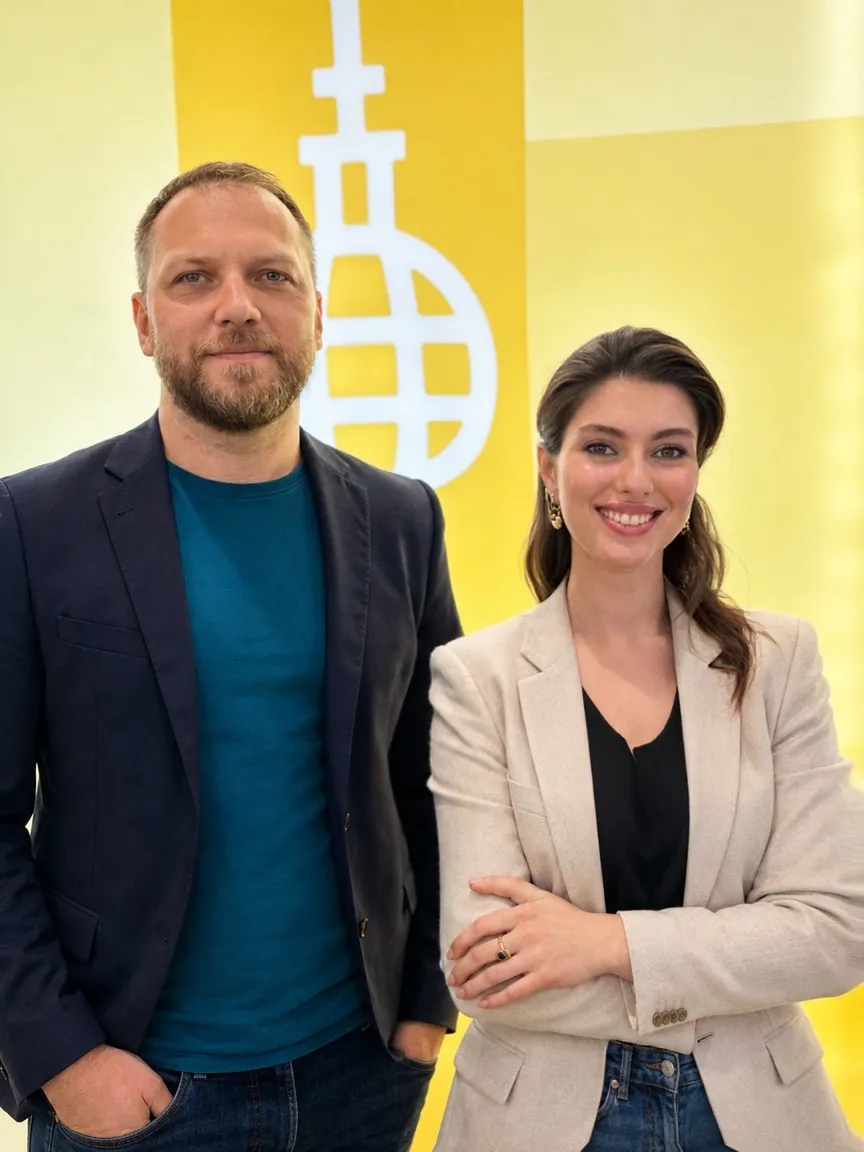
Two founders, one mission: help every innovator in Europe fund what they build.
Our mission
To make public funding genuinely accessible to everyone building something new in Europe. Across research and development, health, agriculture, energy and far beyond, billions are set aside each year to back innovation, yet too much of it never reaches the teams doing the actual work. We want to change that, so that funding lands where it belongs and keeps innovation in Europe moving forward.
From founder to founder: we have been on the client side ourselves, navigating Europe’s funding programmes first-hand, and we learned how much complexity, paperwork and uncertainty stands between a good project and the money meant to support it.
Horizon Europe funding questions, answered
Who qualifies, what is covered, how much, and how hard it is to win.
Horizon Europe is the European Union’s framework programme for research and innovation for 2021 to 2027, with an indicative budget of €93.5 billion. It funds collaborative projects that answer published call topics, mostly through international consortia.
Companies, universities, research organisations, public bodies and NGOs can all apply. Most calls need three independent entities from three different EU Member States or associated countries, at least one in a Member State. The EIC funds single applicants.
Research and Innovation Actions and Coordination and Support Actions are funded at 100% of eligible costs. Innovation Actions are funded at 70% for companies and 100% for non-profits. A 25% flat rate for indirect costs is added on top.
You apply through the EU Funding & Tenders Portal against a specific open call topic. Some calls run in one stage, others in two, where a short proposal is filtered before you are invited to submit in full.
Not in Pillar II, where calls are collaborative and need three partners from three countries. An SME applying alone should look at the EIC Accelerator, which sits in Pillar III and funds single companies.
Very. The overall success rate was 14% as of January 2026. Around 70% of proposals that passed the quality threshold still went unfunded because the call budget ran out. Clearing the threshold is not enough.
Yes, but not on the same costs. Section 7 FZulG allows the Forschungszulage alongside other funding for the same R&D project, but excludes expenses already covered elsewhere, and says this applies to EU money too. See Research Allowance (Forschungszulage).
When the call is competitive, the consortium is large, or nobody in your team has written a 40-page proposal to EU evaluation criteria before. Horizon Europe funding consulting is worth most at the call-selection stage, before the work plan is fixed.
Ask BeFunded anything
Tell us about your project and we'll assess your case by hand. No prep, no obligation. Prefer to talk?
BeFunded is a Berlin consultancy for German and EU R&D funding, and Horizon Europe funding consulting is one part of what it does. If the German research allowance or a national programme suits you better, we will say so. Compare all programmes