
AI Grants in Europe: What AI Startups and SMEs Can Get in 2026 and 2027
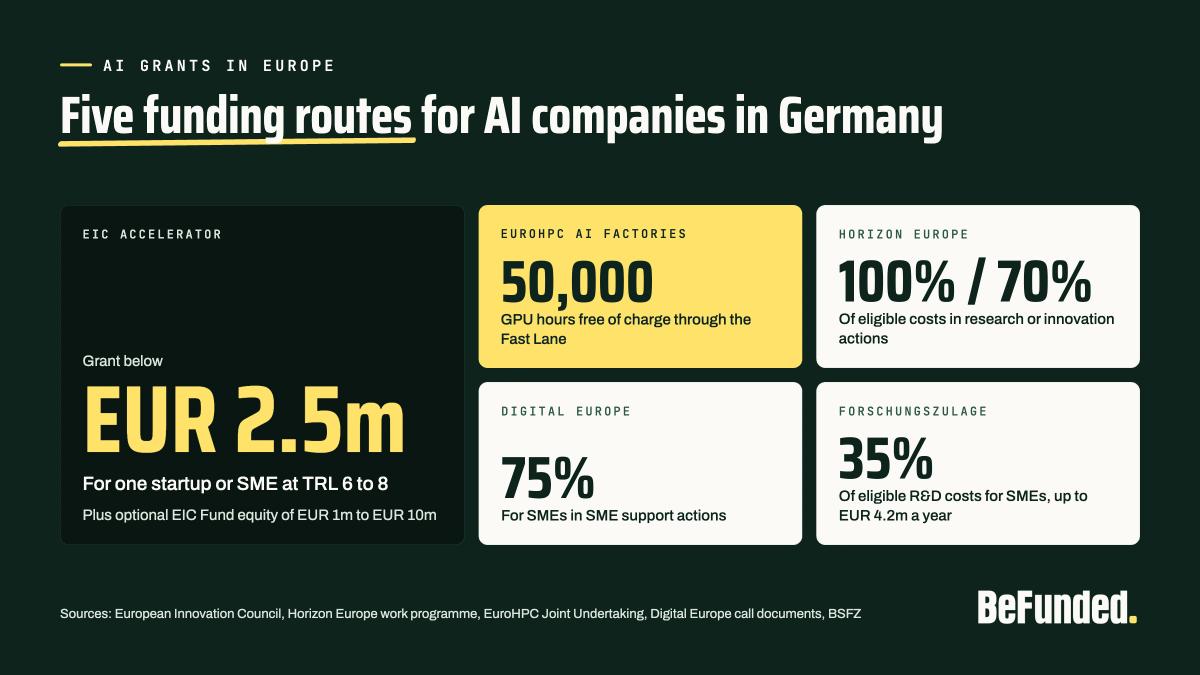
AI grants are non-repayable public funding for a defined artificial intelligence project, either to build AI or to put it to work. For a startup or SME in Germany, five routes are realistic in late 2026: the EIC Accelerator, Horizon Europe AI calls, free EuroHPC compute, Digital Europe support and the Forschungszulage.

Summary
- No AI-specific EIC Accelerator Challenge runs in 2026, so AI startups apply through Accelerator Open, which has a 2026 budget of EUR 414 million.
- Horizon Europe's next Cluster 4 AI call opens on 17 November 2026 and closes on 18 March 2027.
- EuroHPC AI Factories give AI SMEs, including startups, free compute: up to 50,000 GPU hours through the Fast Lane.
- The Forschungszulage pays SMEs 35% of eligible R&D costs, up to EUR 4.2 million a year from 2026, but never on costs an EU grant already covers.
AI grants are non-repayable public funding for a defined artificial intelligence project, either to build AI or to put it to work. For a startup or SME in Germany, five routes are realistic in late 2026. They are the European Innovation Council (EIC) Accelerator, Horizon Europe AI calls, free GPU compute from EuroHPC AI Factories, Digital Europe support for AI adoption and the Forschungszulage, Germany's research allowance.
This guide shows what each pays, which calls are open and how to combine them without funding the same cost twice.
What are AI grants in Europe?
AI grants in Europe are public funds that pay part or all of an AI project's costs and never have to be repaid. Most are awarded through competitive calls with fixed criteria and deadlines. Germany's research allowance works differently: a certification body confirms that your project counts as R&D, and the tax office pays.
For an AI company in Germany, EU AI funding and national money stack in layers. A grant from Brussels pays for a defined project, and free compute from an AI Factory can take the GPU bill off the table. Underneath both sits the Forschungszulage, which returns a share of your in-house R&D costs for each financial year.
Companies that build models or AI products fit research and innovation grants, while companies that adopt AI fit the support services covered further down. For the sector-neutral picture, see our guide to EU grants for startups.
Which EU AI grants can a startup apply for in 2026 and 2027?
Three grants for AI startups are open or opening before March 2027: EIC Accelerator Open, an EIC Pathfinder AI challenge closing on 28 October 2026, and Horizon Europe's Cluster 4 AI calls. There is no AI-specific EIC Accelerator Challenge in 2026.
GenAI4EU, the EIC's generative AI challenge, ran in 2025, and none of the five 2026 Challenges covers AI. AI companies apply through Accelerator Open instead.
The EIC Accelerator is the European Innovation Council's (EIC) grant-plus-equity instrument for single startups and SMEs from EU member states and associated countries. It pays a grant below EUR 2.5 million for TRL 6 to 8 work, plus optional EIC Fund investment of EUR 1 million to EUR 10 million. TRL, the Technology Readiness Level, is the nine-step scale funders use to rate technical maturity. Accelerator Open has EUR 414 million in 2026.
| Who applies | What it pays | Status on 21 October 2026 | |
|---|---|---|---|
| EIC Accelerator Open | One startup or SME | Grant below EUR 2.5m, optional EUR 1m to 10m equity | Last 2026 cut-off: 4 November |
| EIC Pathfinder DeepRAP (cognitive AI) | Single applicant or consortium | EUR 0.5m to 4m at 100% | Closes 28 October 2026 |
| Horizon Europe Cluster 4 AI topics | Consortium | 100% or 70%, by action type | Opens 17 November 2026 |
| AI Gigafactories | Consortia and special-purpose vehicles | Up to EUR 10bn public money in total | Closes 12 November 2026 |
Sources: European Innovation Council, including the DeepRAP topic on the Funding & Tenders Portal and the EIC Work Programme 2026; Horizon Europe work programme 2026 to 2027; EuroHPC Joint Undertaking and the European Commission's AI Factories page. Checked 21 October 2026.
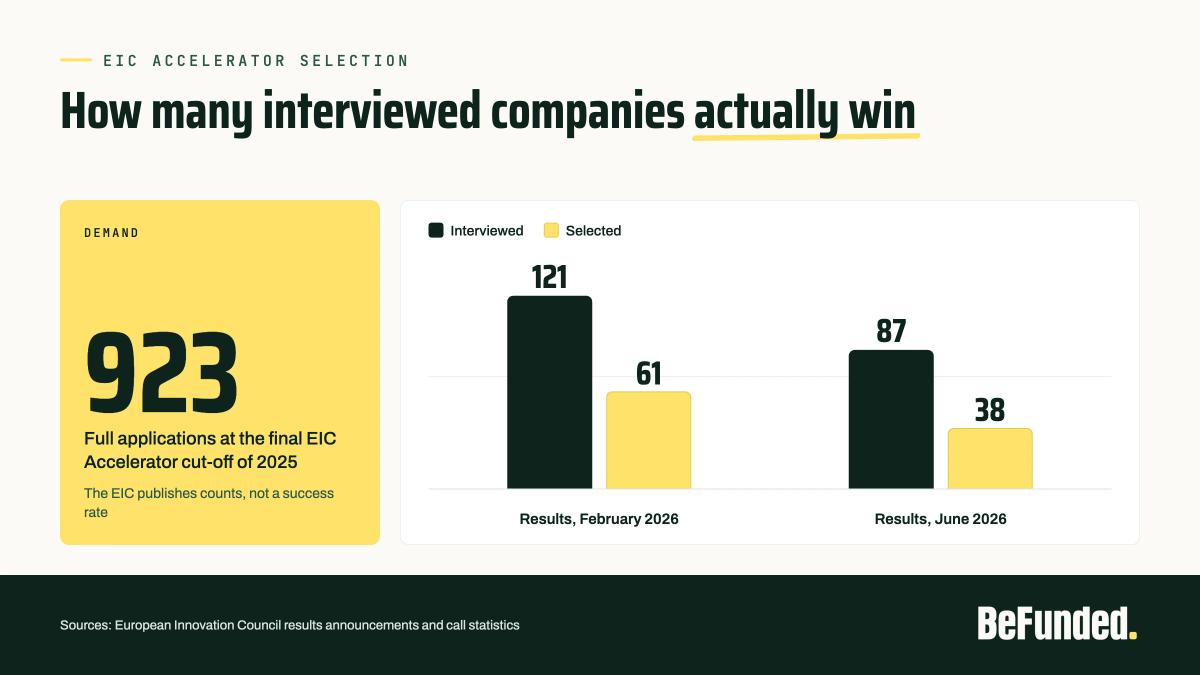
Competition for the EIC Accelerator is stiff, and the EIC publishes counts rather than a success rate. Its final 2025 cut-off drew 923 full applications. In the round announced in June 2026, 38 of the 87 companies interviewed were selected.
You can hold only one EIC Accelerator application at a time. The last full-proposal cut-off of 2026 is 4 November. Our EIC Accelerator grant guide covers the equity terms and the selection numbers behind each round.
For the application stages and the jury interview, see BeFunded's EIC Accelerator programme guide.
How do Horizon Europe AI calls work for companies?
Horizon Europe AI calls fund collaborative projects, so most accept only legal entities that form a consortium. Under the 2026 to 2027 work programme, companies receive 100% of eligible costs in Research and Innovation Actions (PDF) and 70% in Innovation Actions, which sit closer to market.
The AI topics sit in Cluster 4, "Digital, Industry and Space", whose 2027 AI call opens on 17 November 2026 and closes on 18 March 2027. The work programme sets aside EUR 44 million for one frontier AI grant (PDF) in that call. It also funds an Apply AI Booster with EUR 42 million, split into three grants of EUR 14 million. A separate two-stage topic on human and AI collaboration has its first deadline on 2 February 2027.
BeFunded's guide to Horizon Europe structure and clusters shows where Cluster 4 sits.
A BeFunded client with strong digital and AI capability joined a multi-partner Horizon Europe consortium and took ownership of a defined part of the work. Its share came to EUR 1.5 million as a non-repayable grant, mostly covering personnel. Securing the right consortium and role took lead time, so start partner talks months before the deadline. See this example of Horizon Europe AI project funding.
Can an AI startup get free GPU compute from the EU?
Yes. The EuroHPC Joint Undertaking, the EU body that runs Europe's public supercomputers, opens its AI Factories to AI SMEs, including startups, free of charge for innovation purposes. For a team training its own models, that removes one of the largest cost lines.
European Commission President Ursula von der Leyen set out the aim in February 2025: "Our goal is that every company, not only the big players, can access the computing power it needs."
| What you get | Time to decision | |
|---|---|---|
| Fast Lane | Up to 50,000 GPU hours for 1 to 3 months | Within 4 working days |
| Large Scale | More than 50,000 GPU hours for up to one year | Set by each call |
| Playground | Temporarily closed during a platform move | Not applicable |
Source: EuroHPC Joint Undertaking, Fast Lane access to the AI Factories. Checked 21 October 2026.
Two AI Factories are in Germany. According to the High-Performance Computing Center Stuttgart (HLRS), HammerHAI is primarily intended for startups and SMEs and is expected to start operating in the second half of 2026. JAIF, the second German AI Factory, sits in Jülich.
AI Gigafactories are not a startup route. The call for up to seven AI Gigafactories closes on 12 November 2026 and is open to consortia and special-purpose vehicles. The InvestAI initiative's EUR 200 billion target is investment the Commission wants to mobilise, not a pot you can apply to.
Which EU AI funding helps SMEs that adopt AI rather than build it?
If your company uses AI rather than builds it, EU AI funding reaches you through the Digital Europe Programme and the services it pays for, not through research grants. Destatis, Germany's Federal Statistical Office, counted 26% of German companies using AI in 2025.
European Digital Innovation Hubs (EDIHs) are regional centres, funded 50% by Digital Europe, where SMEs can test digital technologies before investing and get financing advice. Since the Commission's Apply AI Strategy of October 2025, the hubs also act as AI Experience Centres. Sector trials run through the EU's Testing and Experimentation Facilities for agri-food, health, manufacturing and smart cities.
| Best-fit route | What it pays | |
|---|---|---|
| You build AI models or products | EIC Accelerator, Horizon Europe, Forschungszulage | Grant below EUR 2.5m; 70% or 100% of project costs; 35% of R&D costs for SMEs |
| You adopt AI in your operations | EDIHs, Testing and Experimentation Facilities, Digital Europe calls | Subsidised services; 75% for SMEs in Digital Europe SME support actions (PDF) |
How does the Forschungszulage combine with EU AI funding?
The Forschungszulage combines with EU AI funding as long as each cost is funded only once. The Forschungszulage is Germany's research allowance under the Research Allowance Act (Forschungszulagengesetz, FZulG): a tax credit on eligible R&D costs, including in-house AI development.
Under the FZulG, SMEs get 35% for activities after 27 March 2024. From 2026 the cost base runs to EUR 12 million, worth up to EUR 4.2 million a year.
The tax office pays out any surplus as a refund, so a company without taxable profit still gets the money. Projects begun after 31 December 2025 also add a 20% flat rate for overheads. Depreciation on equipment such as GPU servers counts if it was bought after 27 March 2024, is used exclusively within your company and is needed for the project.
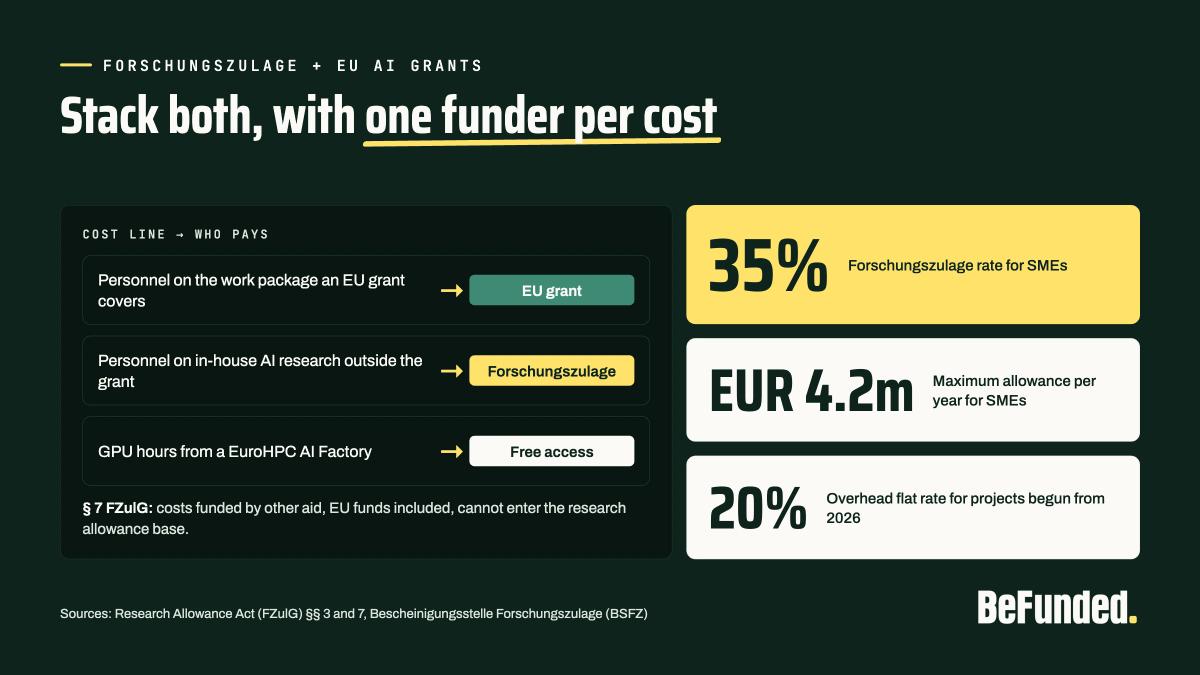
The catch is § 7 FZulG: costs funded under any other aid cannot enter the base, and the exclusion also applies to EU funds. Map every cost line to one funder before you file.
| Funded by | |
|---|---|
| Personnel on the work package an EU grant covers | The EU grant |
| Personnel on in-house AI research outside the grant | Forschungszulage |
| GPU hours from an AI Factory | Free access, nothing to claim |
One BeFunded client received EUR 1.75 million on an eligible base of around EUR 5.1 million from 2024 and 2025. The company built explainable, privacy-compliant document analysis models and had years of in-house R&D without a claim. The Bescheinigungsstelle Forschungszulage (BSFZ), the body that rules on whether a project counts as R&D, certified the work without dispute. Read the case study on the research allowance for AI.
BeFunded's research allowance consulting runs the claim from the first eligibility check to payout.
Which German programmes offer funding for AI startups?
Funding for AI startups in Germany also comes from EXIST, for university spin-offs, and KMU-innovativ, for high-risk research in small and medium-sized companies.
EXIST is run by the Federal Ministry for Economic Affairs and Energy (BMWE). It pays founders a stipend of up to EUR 3,000 a month for 12 months, plus up to EUR 30,000 in material costs for a team. A pilot lets particularly innovative AI projects move on to EXIST's research-transfer phase II, worth up to EUR 180,000. That step is granted only in individual cases.
KMU-innovativ IKT, from the Federal Ministry for Research, Technology and Space (BMFTR), normally pays companies 50% of eligible costs for high-risk software research. Cut-offs fall on 15 April and 15 October. Project outlines must be in German.
Karsten Wildberger, Federal Minister for Digital Affairs and State Modernisation (speech, PDF), put it plainly at Hannover Messe in April 2026: "KI ist der Hebel dieser Dekade." In English: "AI is the lever of this decade" (our translation).
Pre-revenue founders can see how the Forschungszulage fits next to venture capital in our guide to the research allowance for startups.
BeFunded also works as an AI and software funding consultant for teams that want the German and EU routes mapped together.
Why do AI grant applications get rejected?
AI grant applications usually fail because they present routine software work as research, or because they cannot show that the technology is mature enough. Each mistake below is grounded in the funders' own rules.
- Routine software sold as R&D. The Bescheinigungsstelle Forschungszulage (BSFZ) review guide (PDF) says a project cannot be certified if it only solves routine software problems. Fix: name the open technical question and the metric you will move.
- Data protection presented as technical risk. The BSFZ review guide does not count data-protection concerns as R&D risk. Fix: describe the algorithmic uncertainty instead.
- A thin layer on someone else's model. The European Innovation Council treats generative AI as deep tech when it tackles issues such as explainability, hallucinations or transparency. Fix: show what your system solves that the base model cannot.
- Applying too early. The EIC has set the Accelerator's minimum at TRL 6 since 2025. Fix: check your stage in our guide to TRL levels.
- Claiming software licences. BSFZ guidance treats software, licences and usage rights as ineligible assets. Fix: claim the people and equipment behind the research.
- Funding one cost twice. § 7 FZulG removes EU-funded costs from the research allowance base. Fix: one cost line, one funder.
AI grant deadlines from October 2026 to March 2027
Nine dates matter before the end of March 2027, and the first arrives in a week.
| What happens | Who it is for | |
|---|---|---|
| 28 October 2026 | EIC Pathfinder Challenges close, including DeepRAP | Research teams |
| 3 November and 1 December 2026 | EIC short-proposal batches | Startups and SMEs |
| 4 November 2026 | Last EIC Accelerator full-proposal cut-off of 2026 | Startups and SMEs |
| 12 November 2026 | AI Gigafactories call closes | Consortia and special-purpose vehicles |
| 17 November 2026 | Horizon Europe Cluster 4 AI call opens | Consortia |
| 19 November 2026 | EIC online info day on 2027 opportunities | Future EIC applicants |
| 2 February 2027 | Human and AI collaboration topic, first stage | Consortia |
| 18 March 2027 | Cluster 4 AI call closes | Consortia |
Sources: EIC; Horizon Europe work programme 2026 to 2027; EuroHPC Joint Undertaking. Batch dates calculated by BeFunded from the EIC's first-Tuesday rule. Checked 21 October 2026.
BeFunded's EIC Accelerator funding consulting is for AI teams that have completed TRL 5 and want to apply on their own. We test the project against the EIC's deep-tech criteria and time the short proposal back from your target cut-off. Then we build the full proposal, budget and pitch with your team and rehearse the jury interview, all the way to the grant agreement. The fee is a fixed share plus a success component, agreed before work starts.
This guide is general information, not legal, tax or financial advice. Programme rules and deadlines change, so confirm them with the funding body or a qualified adviser before you apply.
FAQ
Single companies can get EU AI funding: the EIC Accelerator accepts single startups and SMEs, EIC Pathfinder Challenges allow single applicants and AI Factory compute goes to individual companies. Most Horizon Europe Cluster 4 calls work differently, because only legal entities that form a consortium can apply unless the call text says otherwise.
AI grants usually need matching funds: Horizon Europe Innovation Actions pay companies 70% of eligible costs, Digital Europe SME support actions pay SMEs 75% and KMU-innovativ IKT normally pays 50%. Your company funds the rest, except in Horizon Europe Research and Innovation Actions and EIC Pathfinder projects, which pay 100%.
An EU AI grant and the Forschungszulage can be combined as long as the two never pay for the same cost. Section 7 of the Research Allowance Act (FZulG) excludes costs already funded by other state aid, EU funds included, so split your cost lines by funder before you file.
The EIC Accelerator is very competitive: its final 2025 cut-off drew 923 full applications. The European Innovation Council then selected 61 of 121 interviewed companies in February 2026 and 38 of 87 in June 2026, and it publishes no official success rate.
AI funding timelines depend on the route: AI Factory Fast Lane requests are approved within 4 working days. The BSFZ decides on a certificate within three months of acknowledging your application, while EIC Accelerator results follow the jury interviews after each full-proposal cut-off.

Related Posts
EU Grants for Startups: What a German Startup Can Apply For in 2026 and 2027
EU grants for startups are non-repayable payments for a defined innovation project, awarded after a competitive call. Five are worth a German startup's time between now and mid-2027: the EIC Accelerator, Eurostars, Women TechEU, the EUIPO SME Fund and cascade funding calls.
 Kirill Rubinstein 15 October 2026 · 11 min read

EIC Accelerator 2026: Grant, Equity, Cut-off Dates and How to Apply
The EIC Accelerator is the funding programme of the European Innovation Council (EIC) for single startups and SMEs taking a breakthrough technology to market. Under the EIC's 2026 rules, it pays a grant below EUR 2.5 million, optional equity of EUR 1 million to EUR 10 million from the EIC Fund, or both. This guide sets out the co-financing you will need and the odds behind the remaining 2026 dates.
Kirill Rubinstein 23 September 2026 · 13 min read 
Horizon Europe Structure: The Three Pillars and Six Clusters Explained
Success rates in the 2026 Horizon Europe Health call ranged from 3.4% to 20% by topic. Here is how the three pillars, six clusters and EUR 93.5 billion budget are structured, and where your project fits.
Kirill Rubinstein 27 July 2026 · 25 min read