

Digital Health Funding in Europe: MedTech and Healthtech Grants for 2026 and 2027
Digital health funding for MedTech and healthtech firms in Germany: EU and German grants, MDR clinical study funding and every deadline to September 2027.

Summary
- Your product's risk class, and whether you apply alone, decide which digital health funding fits.
- The EIC Accelerator is the main EU grant for a single medtech company, for work at technology readiness levels (TRL) 6 to 8.
- In Germany, KMU-innovativ: Medizintechnik funds high-risk device R&D, and a separate federal programme pays for clinical investigations under the Medical Device Regulation (MDR).
- A DiGA listing brings reimbursement, not development money.
- The Forschungszulage, Germany's research allowance, can run beside any grant, as long as no cost is funded twice.
Digital health funding is public money, mostly non-repayable grants and tax incentives, that pays for developing, validating and clinically testing health technology. Two questions decide which programmes a company in Germany can use. Does the product count as a medical device under EU law, and will you apply alone or in a consortium? The answers lead to very different funders, from the European Innovation Council (EIC) to Germany's federal research ministry.
Timing matters as much as fit. Most 2026 health calls have closed, and the next windows open between late October 2026 and March 2027.
What is digital health funding, and which programme fits which product?
The right source of digital health funding depends on your product's maturity, its regulatory risk class and whether you apply alone. The European Commission defines digital health as tools and services that use information and communication technologies to support every stage of healthcare, from prevention and diagnosis to treatment, monitoring and management.
For funding, the dividing line is regulatory. The Medical Device Regulation (MDR) and, for diagnostics, the In Vitro Diagnostic Medical Devices Regulation (IVDR) sort products into risk classes: I to III for devices, A to D for diagnostics. German programmes such as KMU-innovativ: Medizintechnik cover medical device software too.
Most funders measure maturity with the technology readiness level (TRL), which shows how close a technology is to real use. EIT Health uses its own Innovation Maturity Level (IML). Our guide to TRL levels explained for EU grants helps you place your product.
| Who applies | What it pays | Stage gate | Next window | |
|---|---|---|---|---|
| EIC Accelerator | Single startup or SME | Grant below €2.5 million, plus €1 million to €10 million equity | TRL 6 to 8 | Short proposal any time |
| Horizon Europe Cluster 1 Health | Consortium | €5 million to €7 million per point-of-care diagnostics project | Set per topic | 17 Feb 2027 |
| Eurostars (Germany) | SME-led, two or more countries | Up to TRL 6 | 4 Mar 2027 | |
| EIT Health THI | SME with €2 million equity raised | €300,000 to €500,000 per project | IML 6 medtech, IML 7 digital | 2026 call closed |
| KMU-innovativ: Medizintechnik | SME or mid-sized firm | 50% base for industrial research, plus SME bonus | High-risk R&D | 15 Apr 2027 |
| Klinische Validierung | SME, class IIa to III device | 50% pilot, 25% confirmatory base rate | Clinical investigation | 15 Jan 2027 |
| Forschungszulage | SMEs and larger firms | 35% for SMEs, 25% for others | Certified R&D | No call deadline |
Sources: EIC, European Commission, Eureka Network, EIT Health, BMFTR (Bundesanzeiger), DIHK; checked 21 October 2026.
When a window has closed, the same work package often fits a programme that opens sooner.
Which EU grants offer medtech and healthtech funding in 2026 and 2027?
Five EU instruments offer medtech and healthtech funding in 2026 and 2027. The EIC Accelerator serves single companies and EIT Health serves companies that have already raised equity. Horizon Europe Cluster 1 Health and the Innovative Health Initiative (IHI) work through consortia, while Eurostars funds cross-border projects led by small and medium-sized enterprises (SMEs).
EIC Accelerator for single companies
The EIC Accelerator is the European Innovation Council's grant-plus-equity instrument for single startups and SMEs. Its grant funds work at TRL 6 to 8, while EIC Fund equity costs you shares. Short proposals can go in at any time and come back in approximately 4 to 6 weeks, according to the EIC. Our EIC Accelerator programme guide covers each stage.
In the round announced on 15 June 2026, the EIC selected 38 of the 87 companies that reached interview. None of the 2026 EIC Accelerator Challenges covers a health topic, so medtech companies apply through the Open scheme.
Horizon Europe Cluster 1 Health for consortia
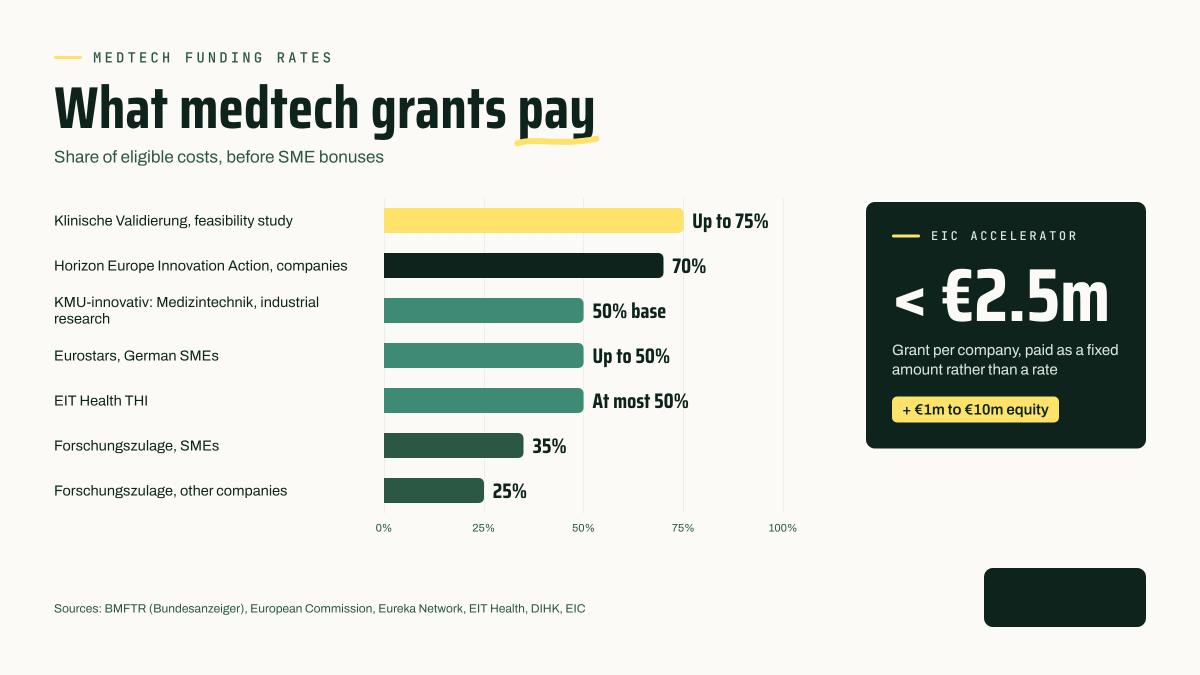
Horizon Europe Cluster 1 is the EU's collaborative health research programme. Its 2027 single-stage call, HORIZON-HLTH-2027-01, opens on 29 October 2026 and closes on 17 February 2027, with an indicative budget of €341.60 million in the Commission's work programme (PDF). The two-stage topic on point-of-care diagnostics is an Innovation Action, which pays companies 70% of eligible costs under the 2026-2027 rules (PDF). Our guide to the Horizon Europe structure and its clusters shows where Cluster 1 sits.
Innovative Health Initiative for industry partnerships
The Innovative Health Initiative (IHI) is a public-private partnership with a €2.4 billion budget for 2021 to 2027, half from the EU. Industry partners cover at least 45% of each project's budget, and IHI funding mainly reaches universities, research organisations, SMEs and mid-sized companies.
EIT Health for companies with a funding round
In its 2026 edition, EIT Health's Transformative Healthcare Instrument (THI) pays at most 50% of a project's costs. It accepts only SMEs with at least four full-time staff that closed €2 million or more in equity in the previous 36 months. The 2026 call closed on 16 September 2026, with no further edition published yet.
Eurostars for cross-border SME projects
Eurostars funds R&D led by an innovative SME with partners in at least two Eurostars countries. In Germany, the Bundesministerium für Forschung, Technologie und Raumfahrt (BMFTR), the federal research ministry, funds only work up to TRL 6 and pays nothing to large companies. Call 12 opens on 17 December 2026. For smaller schemes outside health, see our list of EU grants for startups in Germany.
Which German medical device grants can you apply for?
Germany's main medical device grants are KMU-innovativ: Medizintechnik for high-risk R&D and the Forschungszulage, the federal research allowance, for certified R&D. ZIM is paused, and EXIST serves university spin-offs.
KMU-innovativ: Medizintechnik (SME-innovative: medical technology) is a BMFTR grant for high-risk medtech R&D, usually carried out by an SME with a research institution. The guideline of 19 January 2026 also admits mid-sized companies with up to 1,000 staff and €100 million turnover (PDF, in German). The programme covers medical device software and digital health solutions that could later become medical devices. Our KMU-innovativ programme guide explains the wider scheme.
Class I devices and class A diagnostics qualify only if they are highly innovative, and then only as single SME projects. Under the same guideline, the base rates are 50% for industrial research and 25% for experimental development, plus up to 20 percentage points for small and 10 for medium-sized companies. A de minimis route for small aid amounts pays up to 80% for micro and small companies, capped at €300,000 over three years.
Outlines of up to 10 pages go to VDI Technologiezentrum, the programme's project management agency, by 15 April or 15 October. For outline support, see our KMU-innovativ funding consulting.
The Forschungszulage has no call deadline. From 2026 it pays SMEs 35% of eligible R&D costs on a base of up to €12 million a year. That is worth up to €4.2 million a year, according to the Deutsche Industrie- und Handelskammer (DIHK). Our Forschungszulage guide covers rates and filing.
ZIM has taken no new applications since 7 July 2026 (in German). The Bundesministerium für Wirtschaft und Energie (BMWE), the federal economics ministry, aims to reopen it in early 2027. University teams can start earlier through EXIST research transfer, where the university or research institute applies for the founding team.
Who pays for clinical investigations under the MDR?
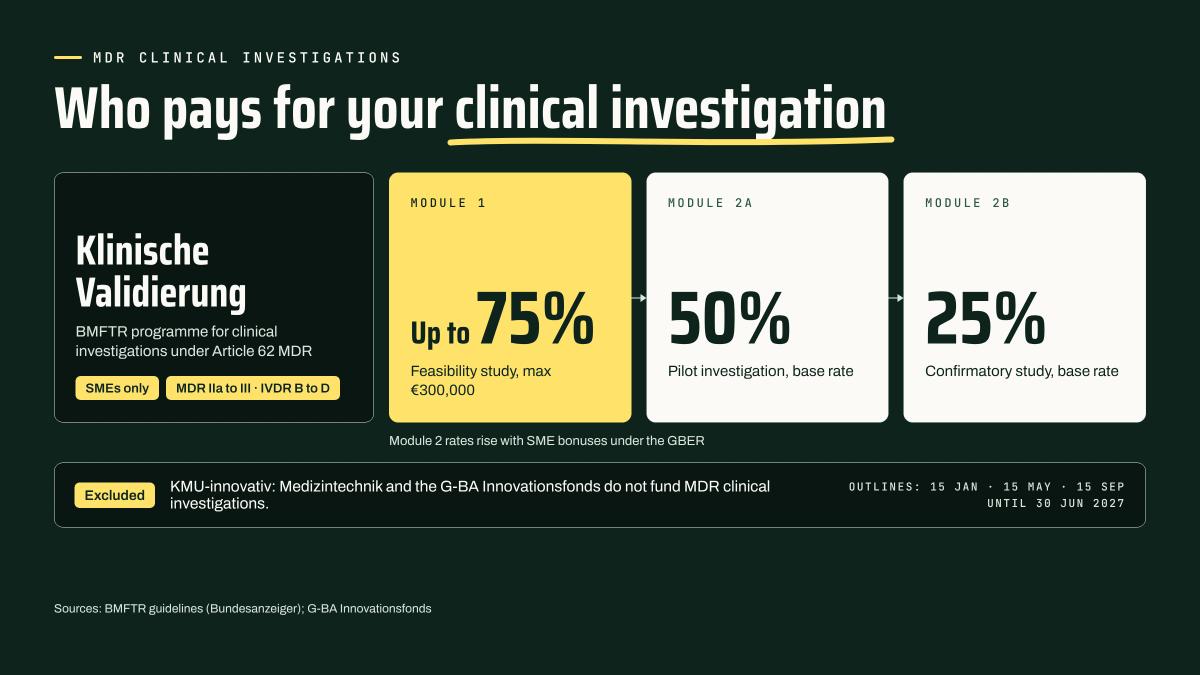
In Germany, the BMFTR pays for clinical investigations under Article 62 of the MDR through Klinische Validierung innovativer medizintechnischer Lösungen (clinical validation of innovative medtech solutions). Only SMEs can apply. KMU-innovativ: Medizintechnik and the Innovationsfonds exclude them.
| MDR clinical investigations (Article 62) | What it funds | |
|---|---|---|
| Klinische Validierung (BMFTR) | Funded in Modules 2a and 2b | Feasibility, pilot and confirmatory studies |
| KMU-innovativ: Medizintechnik (BMFTR) | Excluded | High-risk R&D, including medical device software |
| Innovationsfonds (G-BA) | Excluded | New forms of care and care research |
Sources: BMFTR guidelines (Bundesanzeiger, 2024 and 2026); G-BA Innovationsfonds; checked 21 October 2026.
Under the Klinische Validierung guideline of 19 July 2024, Module 1 pays up to 75% of a feasibility study, capped at €300,000 (PDF, in German). Module 2a funds a pilot investigation at a 50% base rate, and Module 2b a confirmatory study at 25%. Both add SME bonuses under the General Block Exemption Regulation (GBER), the EU's state-aid rulebook.
Klinische Validierung covers MDR classes IIa, IIb and III and IVDR classes B, C and D. Outlines are due by 15 January, 15 May or 15 September until 30 June 2027.
The Innovationsfonds of the Gemeinsamer Bundesausschuss (G-BA), Germany's Federal Joint Committee, spends €100 million a year (PDF, in German) on new forms of care and care research. It excludes R&D on product innovations and MDR clinical investigations, so plan the clinical budget as its own application from the start.
Is a DiGA listing a form of funding?
A DiGA listing is not funding. A Digitale Gesundheitsanwendung (DiGA), a digital health application, becomes reimbursable once the Bundesinstitut für Arzneimittel und Medizinprodukte (BfArM), the Federal Institute for Drugs and Medical Devices, adds it to its directory.
Under § 139e SGB V (in German) of the Social Code, the BfArM decides within three months of a complete application. It can list an app provisionally for up to 12 months of testing, extendable by up to 12 more.
The Innovationsfonds also rules out studies that prove the care effects of a DiGA (in German). Fund the development work through a grant or the Forschungszulage, and treat the DiGA route as market access.
Which EU health funding is closed to German companies?
Three instruments look relevant to German medtech companies but either exclude them or target other applicants. Checking them first saves drafting a proposal that cannot be funded.
- IPCEI Tech4Cure. This State aid project of up to €403 million for medical devices runs in France, Hungary, Italy, Slovakia and Slovenia. The European Commission approved this Important Project of Common European Interest (IPCEI) in July 2025, and Germany does not take part.
- EU4Health. The European Commission's €4.4 billion EU4Health programme for 2021 to 2027 funds health organisations, NGOs and other eligible entities through grants and procurement.
- Eurostars funding for large German companies. Large companies get no German Eurostars money and must fund their own share.
"Tech4Cure will make healthcare better, faster, and cheaper," said Teresa Ribera, Executive Vice-President for Clean, Just and Competitive Transition at the European Commission, in July 2025 (PDF). For German applicants, the realistic EU routes remain the EIC Accelerator, Horizon Europe and Eurostars.
What does a funded medtech project look like?
Digital health funding pays for a defined stretch of development, as one BeFunded EIC Accelerator case shows. A medtech company had a diagnostic device built on sensor fusion and signal processing, but the clinical-grade design and the bench tests to validate it were still ahead. There was no revenue to pay for them, and venture money would have cost a large slice of equity.
The medtech company won a €2.4 million EIC Accelerator grant after the short proposal, full proposal and jury stages. The grant pays for the remaining development and validation, and EIC Fund equity stays available for production scale-up and market entry. Our case on EIC Accelerator funding for a medtech device sets out the route.
If your device or software has completed TRL 5 and you apply alone, BeFunded's EIC Accelerator funding consulting takes the application from a free eligibility check to the jury pitch. We write the short proposal, pitch deck and video, then the full proposal with its lump-sum budget and financial plan.
We also rehearse your team for the expert interview and the jury, which consultants cannot attend. For medtech teams, we scope the grant around the clinical-grade design and validation work that sits inside TRL 6 to 8. The fee is a fixed share plus a success component, agreed before work starts.
Can you combine medtech grants with the Forschungszulage?
Yes. Under section 7 of the Research Allowance Act (FZulG) (in German), the Forschungszulage can run beside other funding on the same project. Any cost already funded elsewhere stays out of the allowance base, including costs paid from EU funds.
| Funding instrument | |
|---|---|
| Confirmatory clinical investigation | Klinische Validierung, Module 2b |
| Bench validation in an EIC work package | EIC Accelerator grant |
| In-house algorithm and firmware development | Forschungszulage |
| Pilot series and commissioning | Outside the Forschungszulage base |
Illustrative split based on section 7 FZulG and the programme rules in this guide.
Our case on the research allowance in manufacturing shows where the line between eligible R&D and production sits for a medtech manufacturer. The company split a laser joining process, its materials and a modular sterile system into three projects. Each project stopped at proof of controllability, before pilot series, commissioning and approval. All three were certified, for about €910,000 at the 35% SME rate on an eligible base of about €2.6 million.
Decide the split before the first application goes in, and keep one cost ledger that assigns every euro to a single instrument. Our research allowance consulting handles the Forschungszulage side of that split.
Digital health funding deadlines from November 2026 to September 2027
Five digital health funding windows open or close between November 2026 and September 2027, starting with the EIC Accelerator cut-off on 4 November.
| Programme | What to do | |
|---|---|---|
| 4 Nov 2026 | EIC Accelerator full proposal | Only if your short proposal passed |
| 17 Dec 2026 to 4 Mar 2027 | Eurostars Call 12 | Submit by 14:00 CET on 4 March |
| 15 Jan 2027 | Klinische Validierung | Send the study outline |
| 17 Feb 2027 | Horizon Europe Health 2027 | Single-stage and stage 1 deadline; stage 2 on 16 Sep 2027 |
| 15 Apr 2027 | KMU-innovativ: Medizintechnik | Send the project outline |
Sources: EIC, Eureka Network, BMFTR (Bundesanzeiger), European Commission; checked 21 October 2026.
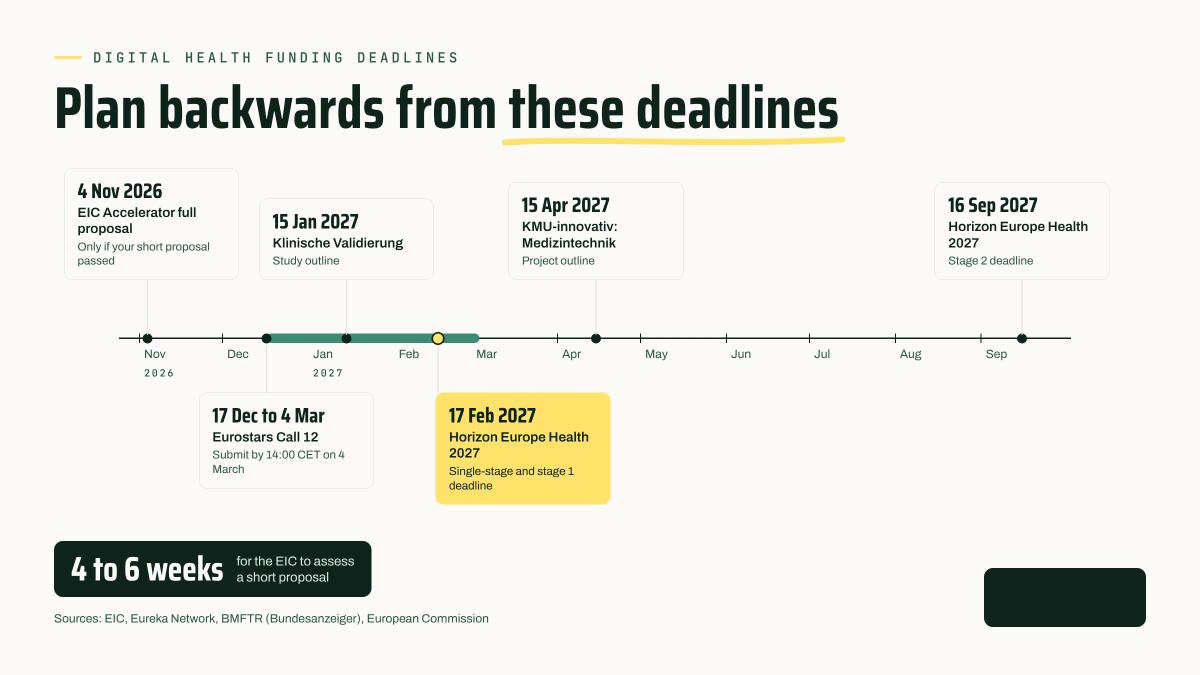
Count back from the month you need the money. EIC short proposals alone take four to six weeks to assess, so a team without a positive result cannot reach the 4 November cut-off. Our MedTech funding consultants can map these dates against your development plan.
This guide is general information, not legal, tax or financial advice. Rules and deadlines change, so confirm them with the funding body or a qualified adviser before you apply.
FAQ
Medical device startups usually combine project grants, such as KMU-innovativ: Medizintechnik or the EIC Accelerator grant, with the Forschungszulage for in-house R&D. Grants pay defined project costs rather than general runway, so plan them around development and validation work packages and use equity for whatever they do not cover.
In 2026, the EIC Accelerator grant is below €2.5 million per company, plus optional EIC Fund equity of €1 million to €10 million. German Eurostars partners share at most €500,000 per project, EIT Health's 2026 instrument paid €300,000 to €500,000, and Horizon Europe point-of-care diagnostics projects get €5 million to €7 million.
No, grants are non-repayable, but few cover all costs: EIT Health pays at most half, German Eurostars funds SMEs at up to 50%, and Horizon Europe Innovation Actions pay companies 70% of eligible costs. EIC Fund money is equity and costs shares.
Yes, the EIC Accelerator funds single startups and SMEs, which makes it the main EU option for a company applying alone. Horizon Europe Cluster 1 and the Innovative Health Initiative work through consortia, and Eurostars needs at least two independent partners from two Eurostars countries, led by an innovative SME.
Yes, on the same project but never on the same costs, because Section 7 FZulG keeps any cost funded by another programme out of the allowance base, including EU funds. Keep one cost ledger that assigns each euro either to the EIC work package or own-funded R&D.

Related Posts

EIC Accelerator 2026: Grant, Equity, Cut-off Dates and How to Apply
The EIC Accelerator is the funding programme of the European Innovation Council (EIC) for single startups and SMEs taking a breakthrough technology to market. Under the EIC's 2026 rules, it pays a grant below EUR 2.5 million, optional equity of EUR 1 million to EUR 10 million from the EIC Fund, or both. This guide sets out the co-financing you will need and the odds behind the remaining 2026 dates.
 Kirill Rubinstein 23 September 2026 · 13 min read

Eureka Eurostars: How SME-Led Cross-Border Consortia Get Funded
Eureka Eurostars funds cross-border R&D projects led by innovative SMEs, with each partner paid at home by its own national funding body, never out of a central Eureka budget. Here is how eligibility, national funding rates and the Call 11 deadline work in practice.
Kirill Rubinstein 18 August 2026 · 14 min read 
Non-Dilutive Funding in Europe: Grants, Tax Incentives and Loans for Startups (2026)
Non-dilutive funding covers grants, tax incentives and loans that finance your company without costing you shares. This guide shows what startups in Europe can get in 2026, what each instrument pays and when the cash actually reaches your account.
Kirill Rubinstein 23 September 2026 · 13 min read