

Grant Consultant: What They Do and How Success Fees Work in Germany & the EU
A grant consultant is an outside adviser who matches your project to a funding programme, writes and assembles the application, and often handles the reporting once the money arrives. Many grant consultants tie part of their fee to the result through a success fee.

Summary
- A grant consultant files the application in your name, but you stay responsible for every claim in it. Only your own team may defend an EIC Accelerator proposal before the jury.
- Free public advice comes first: Germany's national contact point, the NKS EIC Accelerator, and the federal funding advisory service (Förderberatung) both advise at no cost.
- A consultant's success fee on an EU grant cannot be charged to that grant, so it comes out of your own budget.
- Before you sign, pin down three things: what counts as success, which amount the percentage applies to, and when the invoice falls due.
- US guides call percentage fees unethical because US grant and fundraising professionals' ethics codes ban them. The EIC Board, by contrast, describes success fees as an increasingly common practice.
A grant consultant is an outside adviser who matches your project to a funding programme, writes and assembles the application, and often handles the reporting once the money arrives. Many grant consultants tie part of their fee to the result through a success fee. In a February 2025 review, the European Innovation Council (EIC) Board reported that this model has become increasingly common in EU funding. The way that fee is defined and invoiced decides what the help really costs you.
What does a grant consultant do?
A grant consultant turns a project into an application that a funder can score. That means choosing the programme and call, writing the technical and impact case, building the budget and annexes, and submitting before the deadline. Many grant consultants also rehearse interviews and prepare the reports that release each payment after the award.
| Stage | What the consultant does | What stays with you | |
|---|---|---|---|
Programme choice | Matches the project to a programme, call and realistic amount | The decision to apply | |
Writing | Technical case, impact and work plan, written to the scoring criteria | The technical substance and draft reviews | |
Budget and annexes | Budget, financial plan and supporting documents | Real cost data and signatures | |
Submission | Files on the funder's portal in your name | Legal responsibility for the content | |
Interview | Rehearsal and feedback | The pitch itself | |
After the award | Grant agreement, reports and cost statements | Time records and sign-off |
Programme choice is where an experienced consultant saves you the most time. A German company can apply for EU money in Brussels, through its federal state or through a bank, and our EU funding guide maps which route applies to which programme.
The limits matter as much as the services. The European Innovation Council (EIC) Board stresses that EIC Accelerator applicants must personally present and defend their project before a jury. The Board's February 2025 review adds that consultants are not allowed in that room.
You also carry the legal risk. The EIC Board points out that any mistake a consultant makes in your proposal counts as your mistake. Our EIC Accelerator guide explains the three evaluation stages and where the interview sits.
Do you need a grant consultant, or can you apply alone?
You do not need a grant consultant to win EU or German funding. The European Innovation Council (EIC) Board itself says its application system is designed so that applicants need no outside help. A consultant earns the fee when your team lacks the time or the application experience, or when a weak submission would waste a scarce attempt.
Some consultants claim that hiring one is a must for EIC calls. Michiel Scheffer, President of the Board of the European Innovation Council, answered that claim directly in a February 2025 review (PDF): "This claim is manifestly untrue."
Germany offers free help before you pay anyone:
| Service | Who runs it | What it costs | What you get | |
|---|---|---|---|---|
National Contact Point for the Federal Ministry for Economic Affairs and Energy (BMWE) | Free and independent | Advice on the EIC Accelerator and EIC STEP Scale Up applications | ||
Projektträger Jülich (PtJ), on behalf of the federal government | Free hotline | Pointers to federal programmes, plus first information on state and EU funding | ||
EIC business coaching | European Innovation Council | Free after Step 1 | Coaching to sharpen an EIC Accelerator business case |
The odds explain why many companies still pay for help. The EIC received 923 full applications for its 1 October 2025 cut-off. In February 2026, the EIC selected 61 companies from the 121 it interviewed. By our calculation, that round's 61 selections from 923 full applications give a success rate of about 6.6%, as our EIC Accelerator 2026 guide also sets out.
Doing it yourself is realistic for a programme with no competition. Our step-by-step guide shows how to apply for the research allowance in Germany through the Bescheinigungsstelle Forschungszulage (BSFZ), the certification body, and Mein ELSTER, the tax authorities' online portal.
Bring in a grant consultant when:
- your engineers cannot spare the time a full proposal takes
- the budget needs financial modelling your team has never built
- a rejection needs an objection or a resubmission under a deadline
- you want a grant application review that scores the draft before an evaluator does
How do grant consultants charge?
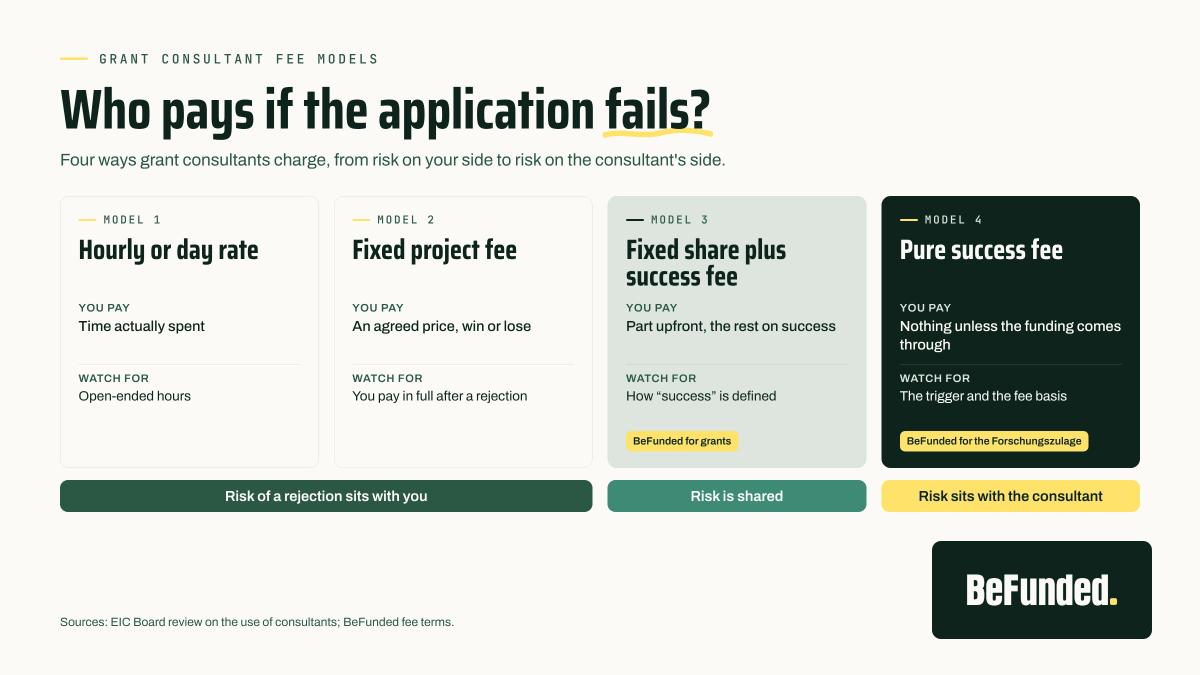
Grant consultants charge in four ways: by the hour, a fixed project price, a success fee on the funding won, or a fixed fee combined with a success fee. The EIC Board describes all four as models in use and stresses that fees are negotiable. Ask at least three consultants for offers before you choose.
| Fee model | What you pay | Who carries the risk | Watch for | |
|---|---|---|---|---|
Hourly or day rate | Time actually spent | You | Open-ended hours | |
Fixed project fee | An agreed price, win or lose | You | You pay in full after a rejection | |
Fixed share plus success fee | Part upfront, the rest on success | Shared | How "success" is defined | |
Pure success fee | Nothing unless the funding comes through | The consultant | The trigger and the fee basis |
In our experience, a grant writing consultant who only drafts text usually bills time, because the outcome depends on things the writer does not control. A consultant who runs the whole file, from programme choice to payout, has more reason to accept part of the risk. Our medtech case on EIC Accelerator funding shows such a file, from short proposal to jury interview.
The EIC Board makes a point that works in both directions. A fixed fee for the days worked is the cheapest option if you win, and an expensive one if you lose.
How do success fees work?
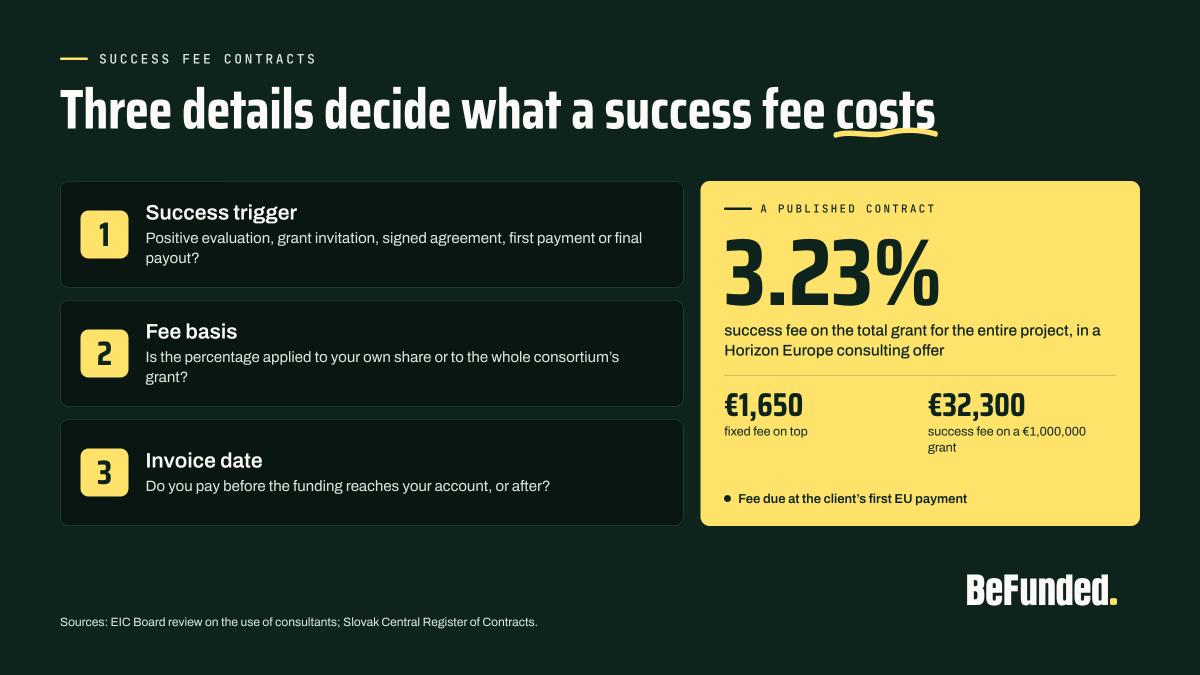
A success fee is a payment that falls due only if the application succeeds, usually calculated as a percentage of the funding. Three contract details decide its real cost: the event that counts as success, the amount the percentage is applied to, and the date the invoice falls due.
What the EIC Board says about success fees
According to the European Innovation Council (EIC) Board's February 2025 review on choosing consultants, success is often defined as a positive evaluation or a proposed grant agreement. Some consultants invoice at the invitation to prepare the grant, others only once the grant agreement is signed. Success fees are often tapered, which means the percentage falls as the grant grows.
Two warnings from the EIC Board's review deserve their own sentence. Consultants' success fees are not eligible costs for the European Commission, so the money must come from your own funds. And if you decide not to sign the grant, the Board considers it normal practice that you still owe the fee.
A published success fee contract
A published contract shows how a success fee looks on paper. A Horizon Europe consulting offer filed in Slovakia's Central Register of Contracts in March 2024 set a success fee of 3.23% of the total grant (PDF) for the entire project. The same offer added a fixed fee of €1,650, and the success fee fell due once the client received its first EU payment.
Read "the entire project" carefully. In a consortium, that basis can be far larger than your own share of the money. On the contract's own example of a €1,000,000 grant, the success fee comes to €32,300.
A tapered success fee in numbers
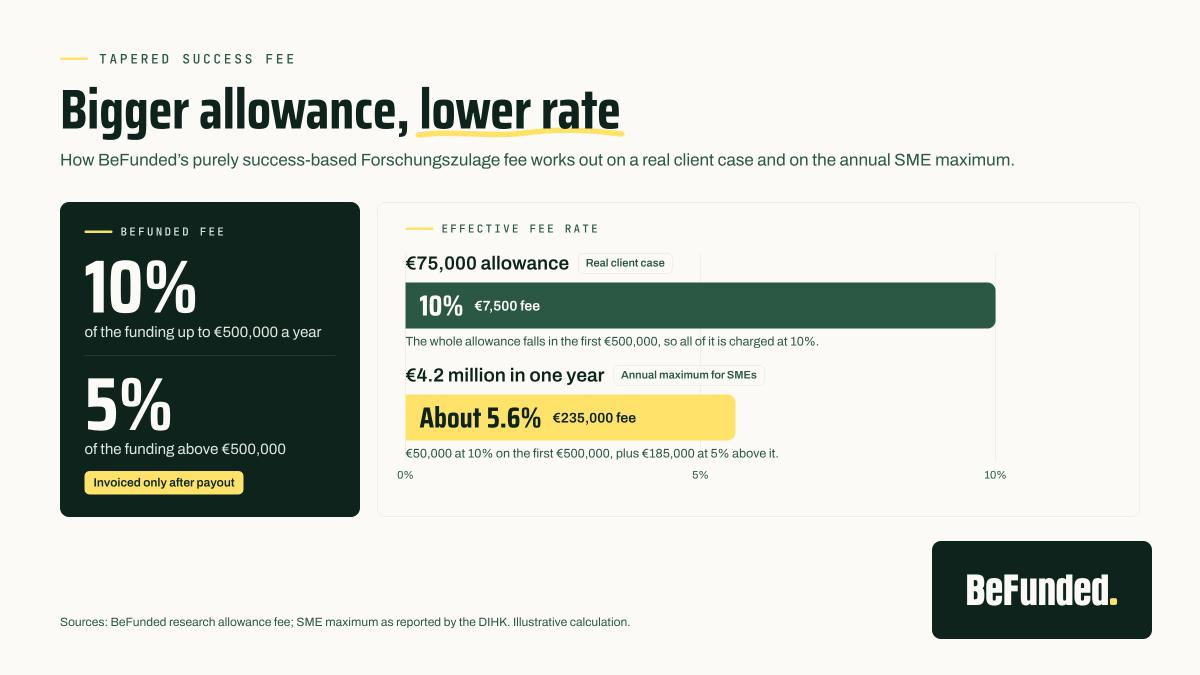
Our research allowance consulting charges a tapered, purely success-based fee: 10% of the funding up to €500,000 a year and 5% above that. We invoice it only after the allowance is paid out.
| Allowance | Fee at 10% | Fee at 5% | Total fee | |
|---|---|---|---|---|
€75,000 | €7,500 | €0 | €7,500 (10%) | |
€4.2 million in one year | €50,000 | €185,000 | €235,000 (about 5.6%) |
Illustrative calculation using BeFunded's published research allowance fee. The €75,000 row is a real client case; the €4.2 million row is the annual maximum for SMEs.
The €4.2 million row uses the annual cap for SMEs. According to the Deutsche Industrie- und Handelskammer (DIHK) in May 2026, the Forschungszulage, Germany's research allowance, pays SMEs up to €4.2 million a year on costs from 2026.
Why do US guides call success fees unethical, and why does EU R&D funding differ?
US guides call success fees unethical because US professional codes ban percentage-based pay. The Grant Professionals Association (GPA) Code of Ethics, revised in June 2023, bars members from taking percentage compensation based on grants. The European Innovation Council's Board, by contrast, describes success fees as an increasingly common practice and tells applicants how to negotiate them.
Most of the advice that ranks for "grant consultant" in English comes from US organisations that serve nonprofits, and their benchmark is the GPA Code. The Association of Fundraising Professionals (AFP) applies the same principle: its Standard 21 bars members from contracts based on a percentage of contributions.
| US grant professionals (GPA members) | EU and German company R&D funding | ||
|---|---|---|---|
Percentage fees | Banned under clause 19 of the GPA Code | In use; the EIC Board explains how to structure them | |
Fee paid from the grant | Only if the funder allows it (clause 20) | Not for EU grants: success fees are not eligible costs | |
Usual model | Salary, wage or fee; bonuses not tied to a percentage of grant money | Fixed fee, success fee or both |
Sources: GPA Code of Ethics, revised 10 June 2023; EIC Board review on the use of consultants, 28 February 2025.
The GPA's reasoning is that a funder awards money for the need, the project and the applicant's capacity, and not purely for the writer's skill. That logic fits foundation and donor grants to nonprofits. In German R&D funding, a success fee instead moves the risk of rejection to the consultant, which suits a company that cannot spare cash on an application that might fail.
What should a grant consultant contract say?
A grant consultant contract should define success, the fee basis and the payment date in plain numbers. It should also keep your proposal text, portal accounts and future applications in your hands. Check these ten points before you sign:
1. Success trigger. Is it a positive evaluation, a grant preparation invitation, a signed grant agreement, the first payment or the final payout?
2. Fee basis. Is the percentage applied to your own share or to the whole consortium's grant?
3. Invoice date. Do you pay before the funding reaches your account, or after?
4. Declining the grant. Do you owe the fee if you choose not to sign?
5. Tapering and caps. Does the percentage fall as the grant grows, and is there a ceiling?
6. Exclusivity. The EIC Board says exclusivity is often limited to 2 to 3 years or 2 to 3 submissions and should lower the success fee.
7. Rights to the text. The EIC Board states that writing or editing your application gives a consultant no author rights, so reject clauses that claim your proposal.
8. Track record and accounts. The EIC Code of Conduct for consultants (PDF) asks consultants to disclose proposals submitted against proposals approved and to give you access to every portal account.
9. Exit terms. How is work billed if you end the contract early? The Slovak contract above set €120 an hour.
10. What happens after the award. The EIC Code of Conduct also asks consultants to state in writing if project management costs are not included. Ask whether grant management consulting is part of the fee.
Success fee in a real case: a research allowance appeal
A success fee changes behaviour when an application fails. Under a purely success-based fee, a rejection means the consultant earns nothing, so the consultant has every reason to fight it.
In our research allowance appeal case, a climate-tech company building infrastructure for verifiable carbon certificates had most of its R&D spend in external contract research. The Bescheinigungsstelle Forschungszulage (BSFZ) rejected the project outright.
The company's objection, filed on time, showed that the outside contractor carried real technical uncertainty and owed a result rather than hours. The BSFZ then certified the project on a €300,000 eligible base, worth a €75,000 allowance at the 25% rate for those years. Our fee followed the payout.
BeFunded's grant writing services start with a fit check: which German or EU programme suits your project, what it could realistically pay, and how many hours your team will need. An engineer-led team then writes the technical case, budget and annexes, files the application in your name and, for the EIC Accelerator, rehearses you for the jury interview. The fee is agreed before work starts: a fixed share plus a success component for grants, and a purely success-based fee for the Forschungszulage.
This article is general information, not legal, tax or financial advice. Check the current programme rules and your contract with a qualified adviser before you sign.
FAQ
A grant consultant has no standard price and charges by the hour, a fixed project fee, a success fee or a mix of these. One Horizon Europe contract filed in Slovakia's contract register in March 2024 combined a €1,650 fixed fee with a 3.23% success fee.
A consultant's success fee cannot be paid from an EU grant, because the EIC Board states that such fees are not eligible costs for the European Commission. Budget it from your own funds, since you may still owe it if you decide not to sign the grant agreement.
Consultants are not allowed in the EIC Accelerator jury interview, and the EIC Board notes that juries recognise applicants who have not understood their own proposal. The job of EIC Accelerator consulting is to rehearse your own team until it can present the project and defend every part of the proposal alone.
Germany's NKS EIC Accelerator gives free advice on EIC applications, and Projektträger Jülich runs the free Förderberatung "Forschung und Innovation" hotline on behalf of the research ministry (BMFTR). Companies that pass Step 1 of the EIC Accelerator can also use free EIC business coaching to strengthen the full proposal.

Related Posts

EIC Accelerator 2026: Grant, Equity, Cut-off Dates and How to Apply
The EIC Accelerator is the funding programme of the European Innovation Council (EIC) for single startups and SMEs taking a breakthrough technology to market. Under the EIC's 2026 rules, it pays a grant below EUR 2.5 million, optional equity of EUR 1 million to EUR 10 million from the EIC Fund, or both. This guide sets out the co-financing you will need and the odds behind the remaining 2026 dates.
 Kirill Rubinstein 23 September 2026 · 13 min read

EU Funding Guide: How the Main Programmes Fit Together
EU funding is money from the European Union budget that reaches companies, researchers and public bodies as grants, loans, guarantees, equity or subsidies. This guide maps the three routes EU money takes, shows where a German company actually applies, and explains how the main European funding programmes connect, stack with national funding and change after 2027.
Kirill Rubinstein 24 September 2026 · 13 min read 
Apply for Research Allowance Germany: Guide 2026
The Forschungszulage, Germany's R&D tax allowance, has been the country's central R&D funding instrument since 2020, and successive amendments have made it considerably more generous. This guide walks through the two-stage route via the BSFZ and Mein ELSTER as it works in practice in 2026.
Kirill Rubinstein 11 April 2026 · 11 min read