

Manufacturing R&D Tax Credit in Germany: What the Forschungszulage Pays Manufacturers in 2026
The manufacturing R&D tax credit in Germany is the Forschungszulage, a tax-based allowance that pays 25% of eligible R&D costs, or 35% for small and medium-sized enterprises (SMEs). Any company taxable in Germany can claim it for a project that is new, technically uncertain and planned.

Summary
- The Forschungszulage pays 25% of eligible R&D costs, 35% for SMEs, up to €3 million or €4.2 million a year from 2026.
- Projects started after 31 December 2025 add a 20% flat rate for overheads. A project that started in 2025 misses it, even on its 2026 costs.
- R&D ends once a process is essentially fixed and the aim becomes getting the production system to run smoothly.
- Test rigs and R&D machinery count only through depreciation, and only if bought after 27 March 2024, used exclusively in the project and necessary for it.
- Claims for the 2022 financial year close on 31 December 2026.
The manufacturing R&D tax credit in Germany is the Forschungszulage, a tax-based allowance that pays 25% of eligible R&D costs, or 35% for small and medium-sized enterprises (SMEs). Any company taxable in Germany can claim it for a project that is new, technically uncertain and planned. There is no jury and no call deadline. The tax office credits the allowance against your tax and refunds the rest, so a plant running at a loss still gets paid.
For manufacturers, the money sits in prototype and process development, including the test rigs that development needs. Eligibility stops where production starts, and German law draws that line more tightly than most plant managers expect.
What is the manufacturing R&D tax credit in Germany?
The manufacturing R&D tax credit in Germany is the Forschungszulage, or research allowance, set out in the Forschungszulagengesetz (FZulG), the Research Allowance Act. The allowance covers basic research, industrial research and experimental development in companies of any size and sector, as our complete Forschungszulage guide explains.
Two bodies decide a claim. The Bescheinigungsstelle Forschungszulage (BSFZ), the certification body, rules on whether the project is R&D, and the tax office (Finanzamt) then sets the amount. Under section 10 FZulG, the tax office credits the allowance at the next income or corporation tax assessment and refunds any surplus in cash. For a manufacturer in a loss year or a heavy investment phase, that refund matters most.
Manufacturers are among the heaviest users. Mechanical engineering filed 17.1% of all Forschungszulage applications in 2025, according to the Federal Government's answer to the Bundestag of 6 May 2026 (PDF, in German). Only IT services filed more, at 17.5%, according to the same answer.
Manufacturing's share follows where German R&D money is spent. The manufacturing sector accounts for almost 80% of internal business R&D spending in Germany, according to the Stifterverband's April 2026 figures for 2024 (PDF, in German). Our Forschungszulage stats for 2026 collect the wider numbers.
The machinery industry noticed early. "The new instrument is becoming a success story in the machinery industry," said Hartmut Rauen, deputy managing director of the VDMA, the German mechanical engineering association, in March 2024. The wording is the English translation published by the ZEW, the Leibniz Centre for European Economic Research in Mannheim.
How much can a manufacturer claim in 2026?
A manufacturer can claim 25% of its eligible R&D costs, or 35% as an SME, under section 4 FZulG. For costs arising after 31 December 2025, the assessment base, meaning the eligible costs the rate applies to, is capped at €12 million a year. The allowance therefore tops out at €3 million, or €4.2 million for an SME.
New projects get more. For projects that began after 31 December 2025, a flat 20% for overheads and other operating costs is added on top of all other eligible costs. At the 35% SME rate, that works out at up to 42% of direct costs (1.2 × 35%).
The 2024 and 2026 rule changes each have their own trigger date, and multi-year plant projects get caught by the difference.
| What triggers it | Effect on a project started in 2025 | |
|---|---|---|
| €12m cap on the base | Date the cost arose | 2026 costs count against €12m |
| €100 per hour for owners' own R&D work | Date the work was done | 2026 hours get €100 |
| 70% of contract research fees | Date the contract was placed | Contracts after 27 March 2024 count at 70% |
| 20% overhead flat rate | Date the project began | No overhead, even on 2026 costs |
Sources: section 3 FZulG; BSFZ, Steuerliches Investitionssofortprogramm. Both checked 20 October 2026.
The overhead rule is the expensive one. A plant project kicked off in late 2025 runs its whole life without the 20% overhead rate.
Illustrative calculation: the rates in euros
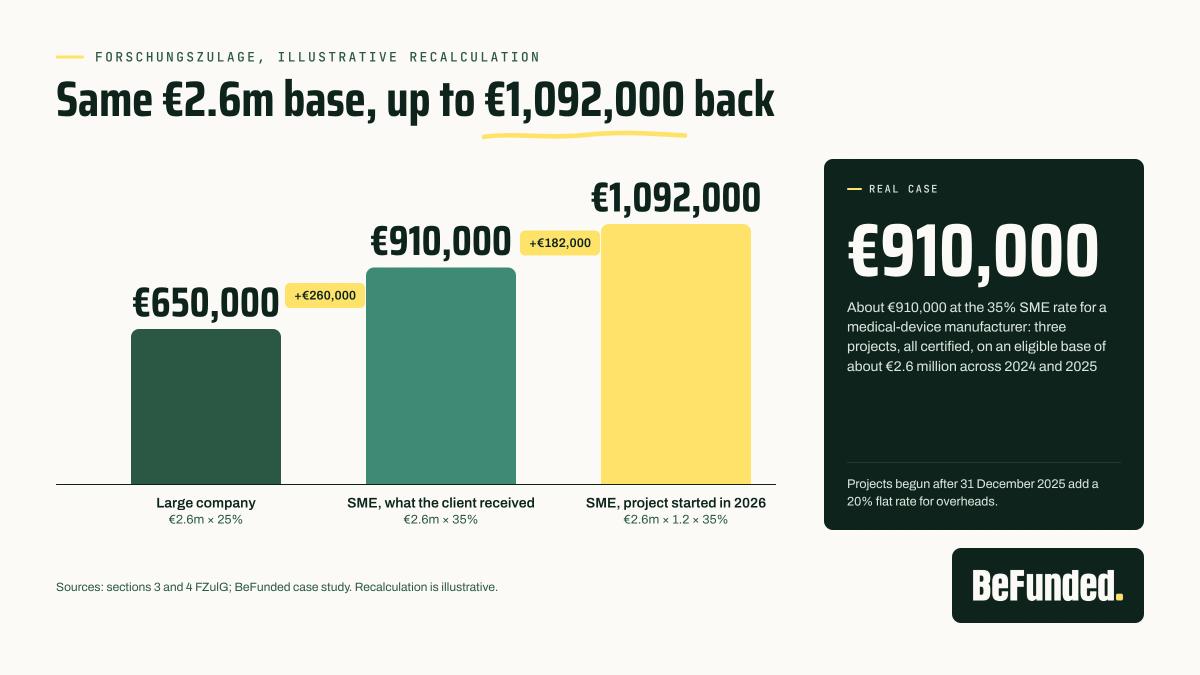
The case study in the next section reached an eligible base of about €2.6 million. The table below applies three settings to that base. The first two rows differ only in SME status. SME status follows the EU definition in Annex I of the General Block Exemption Regulation (GBER), explained in our guide to the SME definition.
| Calculation | Allowance | |
|---|---|---|
| Large company | €2.6m × 25% | €650,000 |
| SME (what the client received) | €2.6m × 35% | €910,000 |
| SME, project started in 2026 | €2.6m × 1.2 × 35% | €1,092,000 |
Illustrative recalculation using the official rates in sections 3 and 4 FZulG. The actual claim covered 2024 and 2025, before the overhead rate existed.
On the €2.6 million base, the overhead rate alone would have been worth €182,000. Our research allowance example calculations apply the same rates to other SME projects.
Which manufacturing work counts as R&D, and where does production start?
Manufacturing R&D counts until the product or process is essentially fixed. Under section 2(2) FZulG, work whose main aim is market development, or getting the production system to run smoothly, is no longer R&D. In our experience, that line usually falls at the functional prototype and the proof that a new process can be controlled.
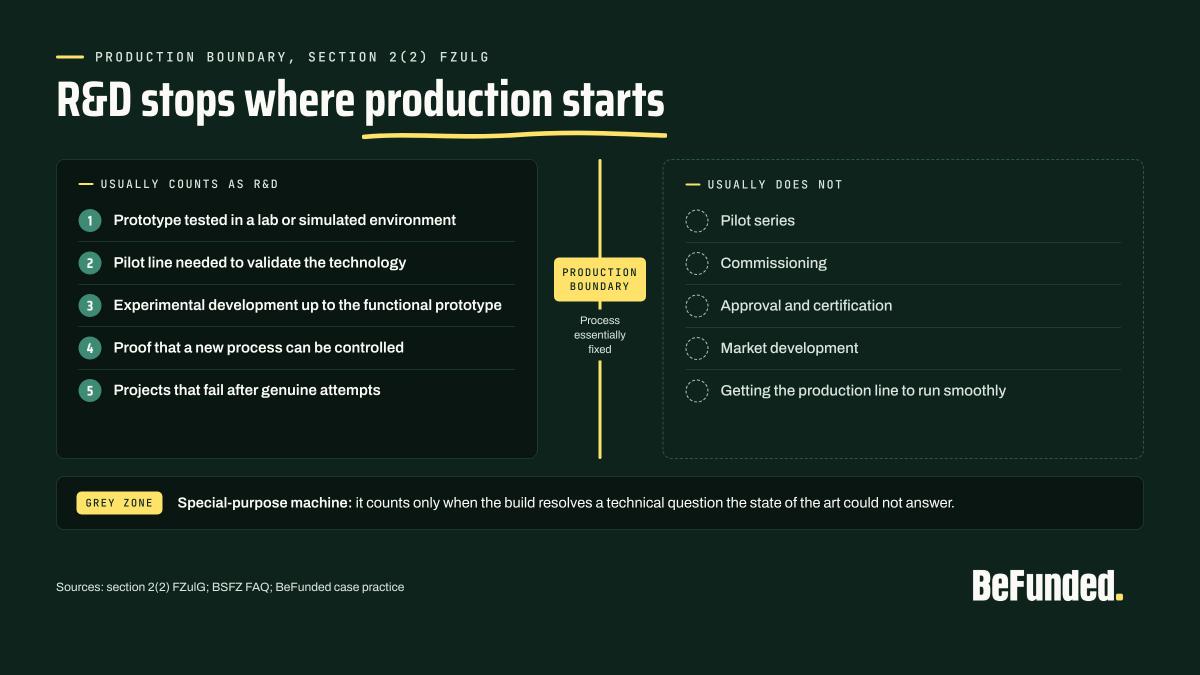
Before the production boundary, the Bescheinigungsstelle Forschungszulage (BSFZ) applies three tests, all of which must be met: novelty, technical risk and a systematic, planned approach. The BSFZ's guidance treats prototypes built in a lab or simulated environment, and pilot lines needed to validate a technology, as part of industrial research. Our BSFZ certificate guide explains how the certification body reads an application.
| Usually counts as R&D | Usually does not |
|---|---|
Experimental development up to the functional prototype | Pilot series |
Proof that a new process can be controlled | Commissioning |
Prototype tested in a lab or simulated environment | Approval and certification |
Pilot line needed to validate the technology | Market development |
Special-purpose machine that resolves a technical uncertainty | Special-purpose machine with no open technical question |
Projects that fail after genuine attempts | Getting the production line to run smoothly |
Sources: section 2(2) FZulG; BSFZ FAQ; BeFunded case practice. Checked 20 October 2026.
The special-purpose machine is the classic grey zone. A one-off build counts only when it resolves a technical question that the state of the art could not answer. The application has to name that question.
Well-scoped manufacturing projects do get through. A March 2024 ZEW and VDMA study found that nearly nine out of ten machinery-industry proposals were approved or at least partly approved in 2023 (PDF, in German).
Case study: three medtech projects, one production boundary
In our case study on research allowance in manufacturing, a medical-device manufacturer was developing three things at once. The strands were a laser process for joining thin multilayer films, materials tuned to that process, and a modular sterile system. Filed as one project, the novelty and risk of each would have blurred.
We split the three strands into separate applications, each with its own metrics and abort criteria. We stopped every one at proof of controllability, before pilot series and approval. All three were certified, on an eligible base of about €2.6 million across 2024 and 2025, producing about €910,000 at the 35% SME rate.
Which plant costs are eligible: staff, contract research and equipment?
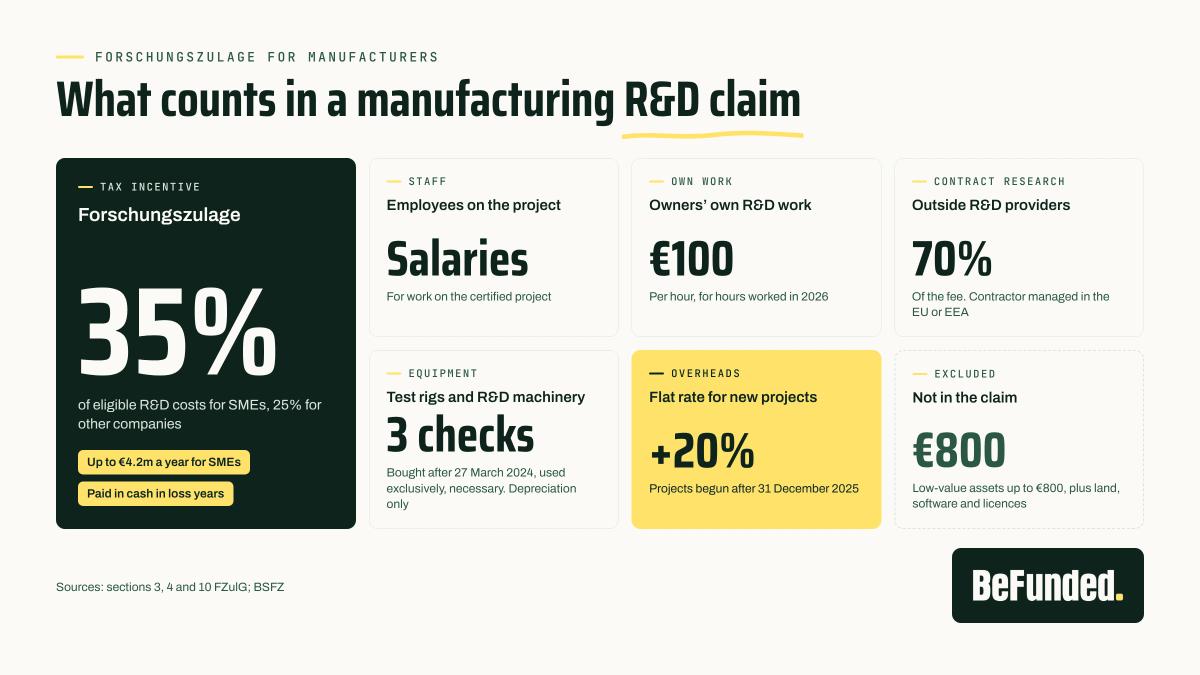
Three cost types carry most manufacturing claims: salaries for work on the certified project, 70% of the fee for contract research, and depreciation on new equipment used only for R&D. A machine enters the claim through its depreciation, never through its purchase price.
Contract research counts at 70% for contracts placed after 27 March 2024, and at 60% before that date. The client claims the allowance, not the contractor, and work passed on to subcontractors drops out. The contractor's management must sit in the EU or the European Economic Area, so an engineering firm in Austria qualifies and a lab in Switzerland does not. Our guide to the research allowance for contract research covers what those contracts should spell out.
Test rigs and R&D equipment: depreciation only
Equipment is where manufacturers most often overestimate. The BSFZ checks each asset against three conditions:
- Bought or built after 27 March 2024, for a project that started after that date
- Used exclusively in the certified project
- Necessary for the chosen solution, with the work-plan sections that need it named in the application
Land, software and licences are excluded, and so are low-value assets of up to €800. A test rig that also runs quality checks for series production fails the exclusivity test.
Timing helps on new kit. Movable assets acquired between 1 July 2025 and 31 December 2027 can use declining-balance depreciation in the claim, which moves more of the value into the first years. Applications filed before equipment could be included can, under conditions, be topped up through a supplementary application (Ergänzungsantrag).
How does Germany's R&D tax credit compare with the US and UK credits?
The manufacturing R&D tax credit in Germany pays a fixed share of the full eligible base each year, with no base amount to beat. Under the IRS Instructions for Form 6765, the US regular credit pays 20% of qualified research expenses over a base amount. According to GOV.UK guidance, the UK's merged R&D expenditure credit is a taxable 20% credit for accounting periods beginning on or after 1 April 2024.
| Germany: Forschungszulage | US: section 41 research credit | |
|---|---|---|
| Rate | 25%, or 35% for SMEs, on the full eligible base | 20% of qualified research expenses over a base amount |
| Contract research | 70% of the fee | Generally 65% |
| Where the work happens | Contractors managed in the EU or EEA | Research outside the US is excluded |
| Where production starts | Not R&D once the process is essentially fixed | Research after commercial production begins is excluded |
| How it pays | Credited at the next assessment, surplus refunded | Claimed on Form 6765 with the return |
Sources: sections 2 to 4 and 10 FZulG; IRS Instructions for Form 6765, revised 12/2025. Checked 20 October 2026.
For a German plant inside a US group, two habits do not travel. Germany has no base-amount test, so the first year of R&D counts in full. The production boundary follows section 2(2) FZulG, not the start of commercial production. Linked companies also share one €12 million cap under section 3(6) FZulG.
How do manufacturers claim the Forschungszulage, and how long does it take?
A claim runs in two stages. The BSFZ certifies the project as R&D, and after the financial year the tax office sets the allowance. The certificate is free and can be applied for before, during or after the project. The BSFZ expects to decide no later than three months after confirming receipt.
1. Define each development strand as its own project, with an objective, a technical risk and abort criteria.
2. Register in the BSFZ portal with an ELSTER organisation certificate, which authenticates your company, and apply.
3. Name each test rig you plan to depreciate and the work-plan sections that need it.
4. File the claim through Mein ELSTER, the tax authority's online portal, after the financial year ends.
5. Receive the allowance through your next tax assessment, or ask the tax office to cut your prepayments first.
Past financial years can still be claimed. Our guide to claiming the research allowance retroactively sets out which years remain and which rate applies to each.
Expect questions after filing. About every second company in the machinery industry faced inquiries or requests for documents from the tax authorities, according to the March 2024 ZEW and VDMA study. Time records and test logs written while the work ran are what close those questions quickly.
The hard part for most manufacturers is the paperwork: separating prototype work from production, tying each test rig to the work plan, and keeping time records the tax office accepts. Our research allowance consulting takes the claim from a free eligibility check to the BSFZ certificate and the annual filing. It needs six to twelve hours of your engineers' time. Our fee is 10% of the allowance up to €500,000 a year and 5% above, invoiced only after payout.
Can you combine the Forschungszulage with ZIM, GRW or other grants?
You can combine the Forschungszulage with other grants on different costs, never on the same ones. A cost that another grant already funds cannot enter the Forschungszulage base. For experimental development, the 25% rate already uses up the maximum EU aid intensity, as the Federal Government confirmed to the Bundestag in May 2026.
The application stop for ZIM grants makes it more urgent to know which instrument covers which cost. ZIM, the Central Innovation Programme for SMEs (Zentrales Innovationsprogramm Mittelstand), has accepted no new applications since 7 July 2026, apart from open international calls. The Federal Ministry for Economic Affairs and Energy (BMWE), which runs ZIM, aims to reopen it in early 2027. For a plant that had planned a ZIM project, the Forschungszulage is the route still open.
Grants for buildings or production equipment, such as the GRW regional investment grant, can sit beside the allowance for development work. The condition is that every cost line maps to exactly one instrument. Our manufacturing and engineering funding consultants help assign each cost line to the right programme.
This guide is general information, not legal, tax or financial advice. Rules and deadlines change, so confirm the details with the BSFZ, your tax office or a qualified adviser before you claim.
FAQ
Process improvement qualifies for the manufacturing R&D tax credit in Germany when the process is new and its outcome was technically uncertain, as with most new joining or forming processes. Routine changes do not count, and under section 2(2) FZulG neither does work to make the production system run smoothly once the process is essentially fixed.
A manufacturer cannot claim the purchase price of a new test rig, only its depreciation. The rig must have been acquired after 27 March 2024, be used exclusively in the certified project and be necessary for it.
Failed development projects still qualify: the BSFZ certifies a project that meets the criteria of novelty, technical risk and a planned approach, whether or not it reached its goal. What matters is that the uncertainty was real at the start and the work followed a documented plan.
A loss-making manufacturer receives the Forschungszulage in cash, because the tax office credits it at the next income or corporation tax assessment and refunds any amount above the tax due. On request, the tax office can also cut tax prepayments by the allowance before the return is filed.
Forschungszulage claims stay open for four years after the end of the year in which the costs arose, according to the BSFZ. The 2022 financial year closes on 31 December 2026 and 2023 a year later, while the certificate itself can be requested even after the project has ended.

Related Posts

Frascati Manual: What Counts as R&D for a BSFZ Certificate
Germany's BSFZ treats the OECD's Frascati Manual as a supporting source, but scores projects on three tests: novelty, technical risk and a methodical plan. Here is how the five criteria map onto the three, and where applications fail.
 Kirill Rubinstein 24 September 2026 · 12 min read

Research Allowance Example Germany for SMEs 2026
The Research Allowance is the central instrument of tax-based research funding in Germany. SMEs have qualified for the increased funding rate of 35 percent since March 2024. For expenses incurred from 2026 the assessment basis runs to EUR 12 million per financial year, which is worth up to EUR 4.2 million in funding. The worked examples below show the principle: no dilution, no repayment, a direct liquidity effect.
Kirill Rubinstein 8 June 2026 · 11 min read 
Research Allowance for Contract Research: Claim 70%
Contract research and the research allowance: the principal claims 70 percent of the fee as eligible cost (for contracts awarded after 27 March 2024), and the contractor must sit in the EU or EEA. Requirements, contract design, a worked example and the mistakes we see most often.
Kirill Rubinstein 6 July 2026 · 6 min read