

Biotech Funding in Europe: Grants and Tax Incentives for 2026 and 2027
Biotech funding in Europe beyond VC: which grants and tax incentives German biotech startups and SMEs can use in 2026, and how far each one reaches.

Summary
- The Forschungszulage, Germany's research allowance, pays 25% of eligible R&D costs, or 35% for SMEs, in cash even in loss years.
- KMU-innovativ: Biomedizin funds drug development up to clinical Phase IIa. The next outline deadline is 15 April 2027.
- German Eurostars partners get no funding for clinical trials, and the Forschungszulage generally excludes Phase IIIb and Phase IV studies.
- A grant and the Forschungszulage can fund the same project, but never the same costs.
Biotech funding is the money a biotechnology company raises to pay for R&D and growth: equity from investors, or non-dilutive grants, tax incentives and loans that cost no shares. In 2025, venture capital for German biotech companies fell 33% to €601 million, according to the EY Biotech Report 2026, so public money now carries more of the plan.
This guide covers the grants and tax incentives that make up public biotech funding for a startup or small and medium-sized enterprise (SME) in Germany in 2026 and 2027. For each one, it shows what the programme pays and how far into clinical development it reaches, with the next deadlines in a closing calendar.
What is biotech funding, and why do grants matter more in 2026?
Biotech funding combines equity rounds with non-dilutive money that pays for defined R&D work. Grants and tax incentives cost no shares, and in Germany they now fill a larger part of the plan because private capital for young biotech companies fell sharply in 2025.
The EY Biotech Report 2026 also counts 1,052 German biotech companies that spent €4.5 billion on R&D in 2025, while total financing fell 5% to €1.8 billion.
The European Commission proposed a European Biotech Act on 16 December 2025, aiming at easier access to funding for start-ups and SMEs and simpler clinical trial rules. It is still a proposal, so nothing in it pays out yet.
On 16 December 2025, Olivér Várhelyi, European Commissioner for Health and Animal Welfare, said: "Under-investment is a major stumbling block for Europe's biotech companies". The Commission and the European Investment Bank (EIB) Group announced BioTechEU the same day. It aims to mobilise €10 billion for biotech and life sciences in 2026 and 2027, as investment rather than grants.
Which biotech grants can a German company apply for in 2026 and 2027?
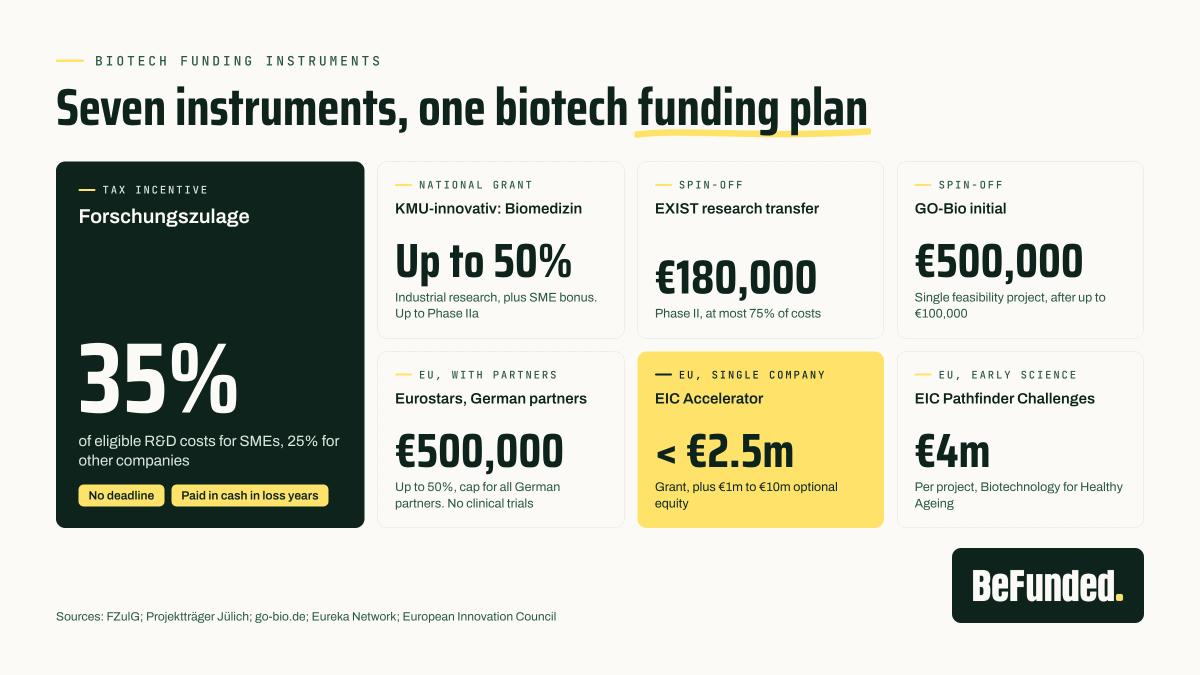
Seven biotech funding instruments matter most for a company in Germany: one tax incentive, one national R&D grant, two spin-off programmes and three EU instruments. They differ mainly in who can apply and how far they reach into clinical development or up the technology readiness level (TRL) scale.
| Who applies | What it pays | Stage limit | Next date | |
|---|---|---|---|---|
| Forschungszulage | Companies taxable in Germany | 25%, or 35% for SMEs | Excludes Phase IIIb and IV | No deadline |
| KMU-innovativ: Biomedizin | SMEs with a German site | Up to 50% plus SME bonus | Up to Phase IIa | 15 April 2027 |
| EXIST research transfer | Institution, then new company | Up to €180,000 in Phase II | Around founding | 30 November 2026 |
| GO-Bio initial | Researchers via their institution | Up to €500,000 | Therapeutics, diagnostics, tools | 15 February, yearly |
| Eurostars, German partner | SME in a two-country consortium | Up to 50%, €500,000 cap | TRL 6, no clinical trials | 4 March 2027 |
| EIC Accelerator | Single startup or SME | Grant below €2.5m, optional equity | TRL 6 to 8 | 4 November 2026 |
| EIC Pathfinder Challenges | Consortia or single applicants | Up to €4m | Healthy-ageing topic | 28 October 2026 |
Sources: FZulG; Projektträger Jülich; go-bio.de; Eureka Network; European Innovation Council; checked 21 October 2026.
KMU-innovativ: Biomedizin is the federal research ministry's grant for high-risk biomedical R&D in small and medium-sized enterprises (SMEs). Projektträger Jülich (PtJ), which runs it, lists up to 50% of eligible costs for industrial research in its April 2026 FAQ (PDF). Small companies can add an SME bonus of up to 20%.
ZIM, the federal economics ministry's grant for applied SME R&D, has accepted no new applications since 7 July 2026, apart from international calls.
Which programme pays for which stage, from lab to clinical trials?
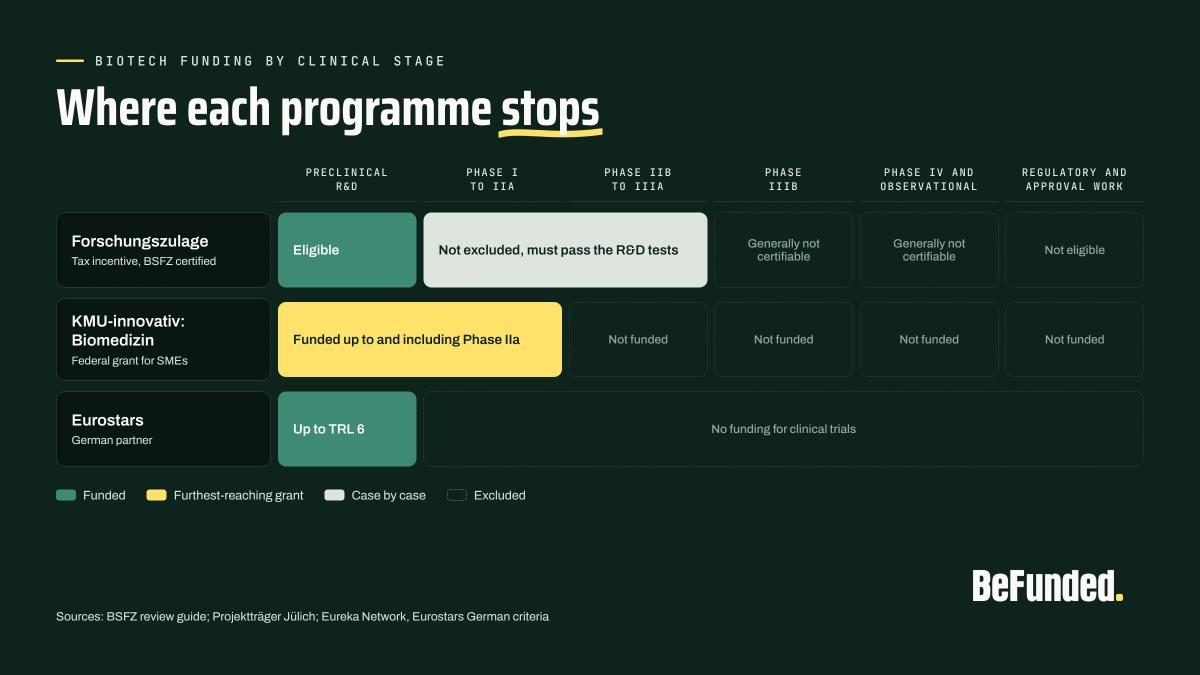
Each biotech funding instrument stops at a different point in clinical development. KMU-innovativ: Biomedizin funds work up to and including Phase IIa, the Forschungszulage excludes Phase IIIb, Phase IV and approval work, and a German Eurostars partner gets nothing for clinical trials.
| Forschungszulage | KMU-innovativ: Biomedizin | Eurostars, German partner | |
|---|---|---|---|
| Preclinical R&D | Yes, if it passes the R&D tests | Yes | Yes, up to TRL 6 |
| Phase I to IIa | Not on the exclusion list | Yes | No |
| Phase IIb to IIIa | Not on the exclusion list | No | No |
| Phase IIIb | Generally not certifiable | No | No |
| Phase IV and observational studies | Generally not certifiable | No | No |
| Regulatory and approval work | Not eligible | No | No |
Sources: BSFZ Prüfleitfaden, Stand 10/2025; Projektträger Jülich; Eureka Network, Call 12 German criteria; checked 21 October 2026.
The Bescheinigungsstelle Forschungszulage (BSFZ) certifies projects for the allowance. Its October 2025 review guide (PDF) lists Phase IIIb and Phase IV studies as generally not certifiable, with exceptions for some Phase IV studies. Phase IIIb is where the approval dossier is prepared, and observational studies and data generated only for approval are excluded too. Clinical phases before IIIb still have to pass the three tests every project faces: novelty, technical risk and a planned approach.
KMU-innovativ: Biomedizin covers preclinical work and clinical studies up to and including Phase IIa, according to Projektträger Jülich (PtJ).
Five mistakes sink biotech applications most often, based on the BSFZ guide and our work as a biotech funding consultant:
- Splitting biology, mechanics and software into three projects when the risk sits where they meet
- Running experiments only to generate approval data
- Calling routine testing and analytics R&D
- Hiring a contract research organisation (CRO) for routine measurements, not an R&D result
- Budgeting clinical work as a German Eurostars partner
How does the Forschungszulage work for biotech companies?
The Forschungszulage is Germany's research allowance: a tax-based incentive under the Forschungszulagengesetz (FZulG) that pays a share of eligible R&D costs, with no jury and no call deadline. Under Section 4 FZulG, it pays 25% of eligible costs, or 35% for SMEs, and loss-making companies receive it in cash.
For costs from 2026, Section 3 FZulG caps the eligible base at €12 million a year, so the allowance tops out at €3 million, or €4.2 million for an SME.
The Bescheinigungsstelle Forschungszulage (BSFZ) certifies that the project is R&D and expects to decide within three months of confirming receipt. After the financial year, the tax office credits the allowance against your tax and refunds any surplus to the company.
Biotech budgets lean on contract research organisations (CROs) and lab consumables, which the FZulG treats differently:
- Staff: wages for R&D work count in full.
- CROs: 70% of the fee counts for contracts placed after 27 March 2024, if the contractor is managed in the EU or in a European Economic Area (EEA) state that provides administrative assistance.
- Lab equipment: depreciation counts for movable assets bought after 27 March 2024 and used solely in the project.
- Consumables: Section 3 FZulG has no line for them. For projects begun after 31 December 2025, a flat 20% on other eligible costs covers overheads and operating costs.
Contract design decides whether a CRO fee counts, as our guide to the research allowance for contract research explains.
The 20% flat rate depends on the project's start date. A project that began in December 2025 never receives it.
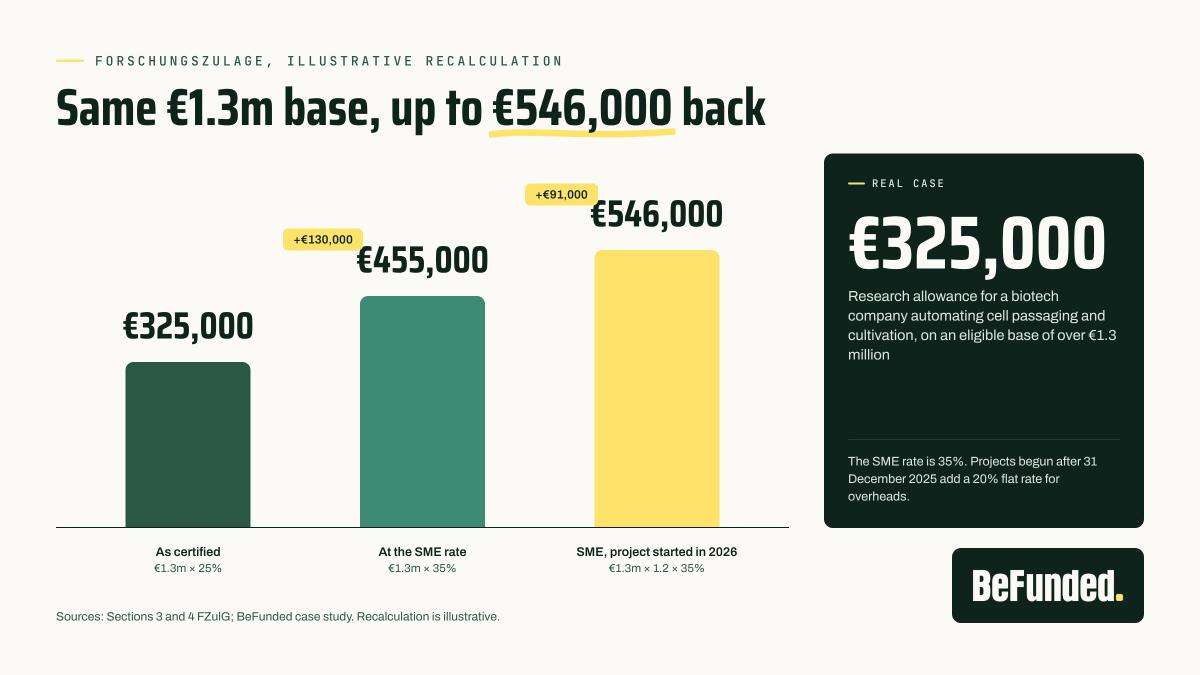
A biotech company we supported was automating cell passaging and cultivation. The risk sat where mechanics, control software and cell biology met, so we framed it as one interdisciplinary project. The BSFZ certified the project. The company received €325,000 on an eligible base of over €1.3 million, as our case on the research allowance for biotech lab automation shows.
| Calculation | Allowance | |
|---|---|---|
| As certified | €1.3m × 25% | €325,000 |
| Same base at the SME rate | €1.3m × 35% | €455,000 |
| SME, project started in 2026 | €1.3m × 1.2 × 35% | €546,000 |
Illustrative recalculation using the rates in Sections 3 and 4 FZulG and the case's €1.3 million base.
On the case's €1.3 million base, the SME rate adds €130,000, and a 2026 start adds another €91,000.
BeFunded's research allowance consulting runs the claim from a free eligibility check through the BSFZ application to the tax office. Your scientists typically spend six to twelve hours on it. Our fee is 10% of the allowance up to €500,000 a year and 5% above, invoiced only after payout.
Biotech startup funding for spin-offs: EXIST and GO-Bio
Before a company exists, biotech startup funding runs through the university or research institute. Two federal programmes carry most of it. EXIST funding for research spin-offs comes from the Federal Ministry for Economic Affairs and Energy (BMWE), and GO-Bio from the Federal Ministry of Research, Technology and Space (BMFTR).
EXIST research transfer (EXIST-Forschungstransfer) starts with Phase I, in which the institution applies for the team. Phase I covers material costs of up to €250,000 over 18 months, or up to 36 for highly innovative projects. In Phase II, the new company can receive up to €180,000, at most 75% of costs, according to Projektträger Jülich (PtJ). Review rounds start on 31 March, 31 August and 30 November.
GO-Bio initial helps life scientists test whether an idea can become a company. Its conceptual phase pays up to €100,000 for 12 months. Selected projects can then receive up to €500,000 for a single project, or €1 million for a consortium, over a 24-month feasibility phase. Outlines are due once a year by 15 February.
GO-Bio next, for experienced founding teams, has no open submission window listed by PtJ. Once a spin-off is incorporated, it can claim the Forschungszulage on in-house R&D that no grant pays for, as our Forschungszulage guide explains.
EU biotech grants: EIC, Eurostars and Horizon Europe
EU biotech grants reach a German company through three routes. The European Innovation Council (EIC) funds single companies, while Eurostars and Horizon Europe need partners abroad.
The EIC Accelerator is the EU's grant-plus-equity instrument for single startups and SMEs. It pays a lump-sum grant below €2.5 million for work at technology readiness level (TRL) 6 to 8, on the EU's nine-step maturity scale. The EIC Fund can add €1 million to €10 million in equity, and grant-only support is available once per company during Horizon Europe.
In the round announced on 15 June 2026, the EIC selected 38 of the 87 companies it interviewed, with Germany among the top five countries.
For earlier science, the EIC Pathfinder Challenges include a 2026 topic, Biotechnology for Healthy Ageing, aimed at interventions against age-related diseases. Grants run up to €4 million per project, and the deadline is 28 October 2026. Our comparison of EIC Pathfinder, Transition or Accelerator shows which instrument fits which stage.
Eurostars funds cross-border R&D led by an innovative SME, with partners from at least two Eurostars countries. In Germany, the Federal Ministry of Research, Technology and Space (BMFTR) pays SMEs up to 50% of eligible costs, capped at €500,000 for all German partners. Only work up to TRL 6 qualifies, and the German criteria state that clinical trials will not be funded. Call 12 opens on 17 December 2026 and closes on 4 March 2027.
One of our clients, a German biotech SME, built a new assay with a partner company abroad. The BMFTR covered around half of its eligible costs, a €460,000 grant, as our case on Eurostars funding for biotech R&D shows.
Horizon Europe's health calls are consortium projects. Under the 2026 to 2027 work programme, innovation actions pay for-profit companies 70% of eligible costs (PDF), and research and innovation actions pay 100%.
Can you combine biotech grants with the Forschungszulage?
Yes: biotech funding from a grant and the Forschungszulage can cover the same project, but never the same costs. Section 7 of the Forschungszulagengesetz (FZulG) lets the Forschungszulage run next to other funding, but any cost another programme funds is excluded, EU grants included. Keep one cost ledger that assigns every euro to exactly one instrument.
- Allowed: the Forschungszulage on in-house assay work while Eurostars pays a separate work package
- Not allowed: the same scientist's hours in both budgets
One eligibility rule hits biotech harder than most sectors. Under Section 9(2) FZulG, undertakings in difficulty have no claim to the allowance, and most grants under the EU's General Block Exemption Regulation (GBER) exclude them too. SMEs under three years old are exempt from the capital-loss test. From year three, a company fails it once accumulated losses exceed half of its subscribed capital, share premium included.
Run this check before every application:
- Is the company older than three years?
- Do accumulated losses exceed half of subscribed capital plus share premium?
- Are insolvency proceedings open, or could creditors request them?
- Do the same answers hold for parent and sister companies?
Our guide to GBER and de minimis rules covers the full test and how to fix a failing balance sheet.
Biotech funding deadlines from October 2026 to April 2027
Seven biotech funding dates fall between late October 2026 and mid-April 2027, and the first two come before 5 November 2026. The Forschungszulage has no deadline, so it runs alongside any call.
| Programme | What to do | |
|---|---|---|
| 28 October 2026 | EIC Pathfinder Challenges | Submit a healthy-ageing proposal |
| 4 November 2026 | EIC Accelerator, full proposals | Only if your short proposal passed |
| 30 November 2026 | EXIST research transfer, Phase I | Next review round starts |
| 17 December 2026 | Eurostars Call 12 opens | Confirm your partner abroad |
| 15 February (yearly) | GO-Bio initial | Submit the project outline |
| 4 March 2027, 14:00 CET | Eurostars Call 12 closes | Submit the joint application |
| 15 April 2027 | KMU-innovativ: Biomedizin | Submit the project outline |
Sources: European Innovation Council; Projektträger Jülich; BMWE; go-bio.de; Eureka Network; checked 21 October 2026.
EIC short proposals are batched on the first Tuesday of each month, and feedback takes about four to six weeks.
This guide is general information, not legal, tax or financial advice. Programme rules and deadlines change, so confirm them with the funding body or a qualified adviser before you apply.
FAQ
Yes: under Section 10 of the Forschungszulagengesetz (FZulG), the tax office credits the allowance against assessed tax and pays out any surplus in cash. Section 9(2) FZulG excludes undertakings in difficulty, but SMEs under three years old are exempt from the capital-loss test.
Partly: the October 2025 review guide of the Bescheinigungsstelle Forschungszulage (BSFZ) treats Phase IIIb, Phase IV with some exceptions, observational studies and approval-only work as generally not certifiable. Earlier clinical phases are not on that list, but each project must still pass the BSFZ's three R&D tests.
No: the EIC Accelerator grant, a lump sum below €2.5 million for TRL 6 to 8 work, costs no shares. The optional €1 million to €10 million EIC Fund investment is equity and dilutes shareholders, and grant-only support is available once per company during Horizon Europe.
A biotech startup gets pre-incorporation funding through its university or research institute, mainly from EXIST research transfer and GO-Bio, both managed by Projektträger Jülich. EXIST covers Phase I material costs of up to €250,000, and GO-Bio initial pays up to €100,000, then up to €500,000 for a single feasibility project.

Related Posts

Non-Dilutive Funding in Europe: Grants, Tax Incentives and Loans for Startups (2026)
Non-dilutive funding covers grants, tax incentives and loans that finance your company without costing you shares. This guide shows what startups in Europe can get in 2026, what each instrument pays and when the cash actually reaches your account.
 Kirill Rubinstein 23 September 2026 · 13 min read

EU Grants for Startups: What a German Startup Can Apply For in 2026 and 2027
EU grants for startups are non-repayable payments for a defined innovation project, awarded after a competitive call. Five are worth a German startup's time between now and mid-2027: the EIC Accelerator, Eurostars, Women TechEU, the EUIPO SME Fund and cascade funding calls.
Kirill Rubinstein 15 October 2026 · 11 min read 
Digital Health Funding in Europe: MedTech and Healthtech Grants for 2026 and 2027
Digital health funding for MedTech and healthtech firms in Germany: EU and German grants, MDR clinical study funding and every deadline to September 2027.
 Aydan Aliyeva 6 November 2026 · 14 min read