

EIC Pathfinder, Transition or Accelerator: Which EIC Instrument Fits Your Project in 2026?
EIC Pathfinder, EIC Transition and the EIC Accelerator each screen applicants on technology readiness, applicant type and prior EU results. This guide compares the three instruments, their 2026 budgets and deadlines, and how EIC money works alongside the Forschungszulage.

Summary
- EIC Pathfinder funds research consortia at technology readiness levels (TRL) 1 to 4 with grants of up to EUR 4 million in 2026; single applicants can enter only Pathfinder Challenges.
- EIC Transition only accepts proposals built on results from an earlier EU-funded project at TRL 3 completed or TRL 4.
- In 2026, the EIC Accelerator gives single start-ups and small and medium-sized enterprises (SMEs) a grant below EUR 2.5 million plus optional equity of up to EUR 10 million.
- You can claim the Forschungszulage on the same project as an EIC grant, never on the same costs.
EIC Pathfinder, EIC Transition and the EIC Accelerator are the three core funding instruments of the European Innovation Council (EIC), Horizon Europe's deep-tech funder. Three facts decide which one fits: how mature your technology is, whether you apply as a company or a research consortium, and whether you hold results from an EU-funded project.
Pick the wrong instrument and the proposal can be ruled ineligible before an evaluator scores it. For German companies, one more question matters: how EIC money sits next to the Forschungszulage, the country's R&D tax allowance.
Which EIC instrument fits your project?
The right EIC instrument depends on your stage and what you already hold. Research teams exploring an idea at TRL 1 to 4 belong in EIC Pathfinder. Holders of results from an EU-funded project should look at EIC Transition. The EIC Accelerator is built for a single start-up or SME whose technology has been validated in a relevant environment.
Technology readiness level (TRL) is the EU scale for how mature a technology is, from TRL 1 (early research) to TRL 9 (proven in operation).
| EIC Pathfinder | EIC Transition | EIC Accelerator | |
|---|---|---|---|
| Stage | TRL 1 to 4 | From TRL 3 completed or 4, towards TRL 5 or 6 | TRL 6 to 8 for the grant |
| Who applies | 3+ entities from 3 countries; single applicants only in Challenges | Single SMEs, start-ups or research organisations, or 2 to 5 partners | Single start-ups and SMEs |
| Entry ticket | A radically new technology vision | Results from an eligible EU project | TRL 5 completed |
| Maximum grant | EUR 4 million | EUR 2.5 million | Below EUR 2.5 million, plus up to EUR 10 million equity |
| 2026 budget | EUR 262 million | EUR 100 million | EUR 634 million |
Sources: EIC 2026 work programme and EIC programme pages, checked 6 October 2026.
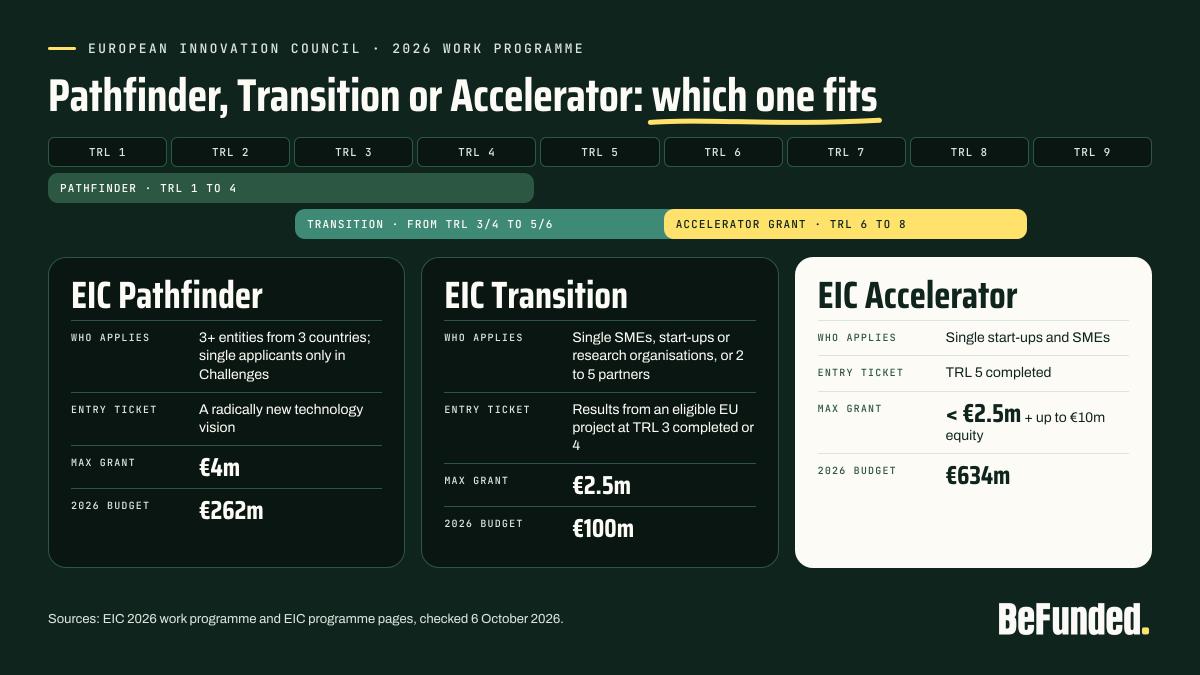
If you are unsure where your technology sits, read TRL levels explained for EU grants, which gives the official EU wording for every level. The hard failures sit in the "Who applies" and "Entry ticket" rows: a start-up alone cannot enter Pathfinder Open, and Transition rejects proposals without results from an eligible EU project.
What is the EIC Pathfinder, and who can apply?
The EIC Pathfinder is a Horizon Europe grant for research teams building the scientific basis of a radically new technology, from TRL 1 to 4. In 2026 it pays up to EUR 4 million per project, more if duly justified.
For Pathfinder Open, you need at least three independent legal entities. One must be established in an EU Member State, and at least two more must each sit in a different Member State or Horizon Europe associated country. Only Pathfinder Challenges accepts single applicants and two-partner consortia.
Pathfinder Open takes ideas from any field and has a 2026 budget of EUR 166 million. Pathfinder Challenges funds topics defined with EIC programme managers and has EUR 96 million for 2026. The 2026 Challenge topics are materials for miniaturised energy harvesting, biotechnology for healthy ageing, and trustworthy cognitive AI.
Evaluators look for science on its way to a technology. They want a convincing long-term vision and a concrete breakthrough, pursued through a high-risk, high-gain method with plausible objectives. A product roadmap alone does not meet these criteria.
Competition is stiff. In the 2025 Pathfinder Challenges call, the EIC funded 30 of 647 eligible proposals, roughly 1 in 22 by our count. Its participants were 29 percent private for-profit organisations, 41 percent higher education institutions and 24 percent research organisations, so companies do win places.
Funded projects can add EIC booster grants of up to EUR 50,000 to test commercial potential. The 2026 work programme also raised the maximum Pathfinder grant, so guides that still quote a lower cap are out of date.
What does an EIC Transition grant fund, and who is eligible?
An EIC Transition grant pays up to EUR 2.5 million in 2026 to take lab results towards TRL 5 or 6 and build a business case. The catch: your proposal must build on results from an earlier EU-funded project, and those results must sit at TRL 3 completed or TRL 4. Any other starting level is ineligible.
Eligible precursor projects:
- EIC Pathfinder projects, including earlier Future and Emerging Technologies (FET) projects
- European Research Council (ERC) Proof of Concept grants
- Pillar II research and innovation actions, and their Horizon 2020 equivalents
- Research Infrastructures actions, eligible from 2026
- European Defence Fund research, if your Transition proposal targets civil applications (including dual-use)
Our Horizon Europe structure guide explains Pillar II.
You can apply alone as a start-up, SME or research organisation, or as a consortium of two to five partners. A large company cannot apply on its own. Results from a purely national German project do not qualify.
The 2026 rules also put a clock on the precursor project. According to December 2025 slides from the UK National Contact Point for the EIC, an ongoing precursor project must have started more than 18 months before the deadline (PDF). A finished one must have ended within the last 24 months.
| Rule | For the 16 September 2026 cut-off | |
|---|---|---|
| Still running | Started more than 18 months before the cut-off | Started before 16 March 2025 |
| Still running, ERC Proof of Concept | Started more than 6 months before | Started before 16 March 2026 |
| Finished | Ended within 24 months of the cut-off | Ended on or after 16 September 2024 |
Illustrative dates calculated by Be-Funded from the 2026 rules; the 2027 cut-off has not been published yet.
Selection is tight. In the round announced in February 2026, the EIC selected 40 projects from 611 submissions, about 1 in 15.
When is the EIC Accelerator the better route?
The EIC Accelerator is the better route when a single start-up or SME has completed TRL 5 and needs money to finish development and reach the market. In 2026 it pairs a grant below EUR 2.5 million for TRL 6 to 8 work with an optional EIC Fund equity investment of EUR 1 million to 10 million.
The grant is a fixed lump sum for work completed within 24 months, and a company receives grant-only support once during Horizon Europe. Our EIC Accelerator programme guide covers each stage and funding mode.
The Accelerator has three stages:
- Submit a short proposal.
- Write a 20-page full proposal, then take an online interview with a technology expert.
- Pitch to the EIC jury, which only sees the top-ranked proposals worth 2.5 times the available grant budget.
In the round published in June 2026, the EIC selected 38 of the 87 companies that reached the jury, and Germany was among the five countries with the most winners.
The 2026 work programme made the route faster. At its adoption in November 2025, Ekaterina Zaharieva, European Commissioner for Startups, Research and Innovation, said "we are reducing bureaucracy, accelerating funding, and launching solutions for new challenges", as reported by Eunews.
An anonymised Be-Funded client had a diagnostic device built on sensor fusion and signal processing, but still needed a clinical-grade design and the bench tests to validate it. Be-Funded took the application through all three stages, and the EUR 2.4 million grant now pays for that finishing work, with EIC Fund equity available for the scale-up. Our EIC Accelerator medtech case study details the route.
Can German companies apply for the EIC Pre-Accelerator?
No. The EIC Pre-Accelerator is open only to single SMEs in Horizon Europe widening countries, the group with lower innovation performance such as Poland, Portugal and Estonia. Comparable associated countries and the EU's outermost regions also qualify. Germany is none of these, and the EIC bases eligibility on the country of establishment alone.
The next EIC Pre-Accelerator call opens on 5 May 2027 and closes on 18 November 2027, with EUR 500,000 to 1 million per company. For a German start-up at TRL 4 to 6, the stage the Pre-Accelerator targets, two realistic EIC routes remain. EIC Transition fits if the start-up holds eligible EU results, and the EIC Accelerator opens once TRL 5 is complete.
How do Pathfinder, Transition and Accelerator connect?
The European Innovation Council's three instruments form a staged route with built-in shortcuts. The Fast Track lets projects from Horizon Europe or Horizon 2020, including Pathfinder and Transition, enter the Accelerator directly at the full-proposal stage after a review of the ongoing project.
- Use EIC Pathfinder to prove the science behind a new technology, up to TRL 4.
- Move eligible results into EIC Transition to validate the technology and build a business case.
- Enter the EIC Accelerator through the Fast Track to finish development and scale up.
The Plug-In scheme gives certified national or regional programmes the same direct route, and the EIC lists 50 certified programmes so far.
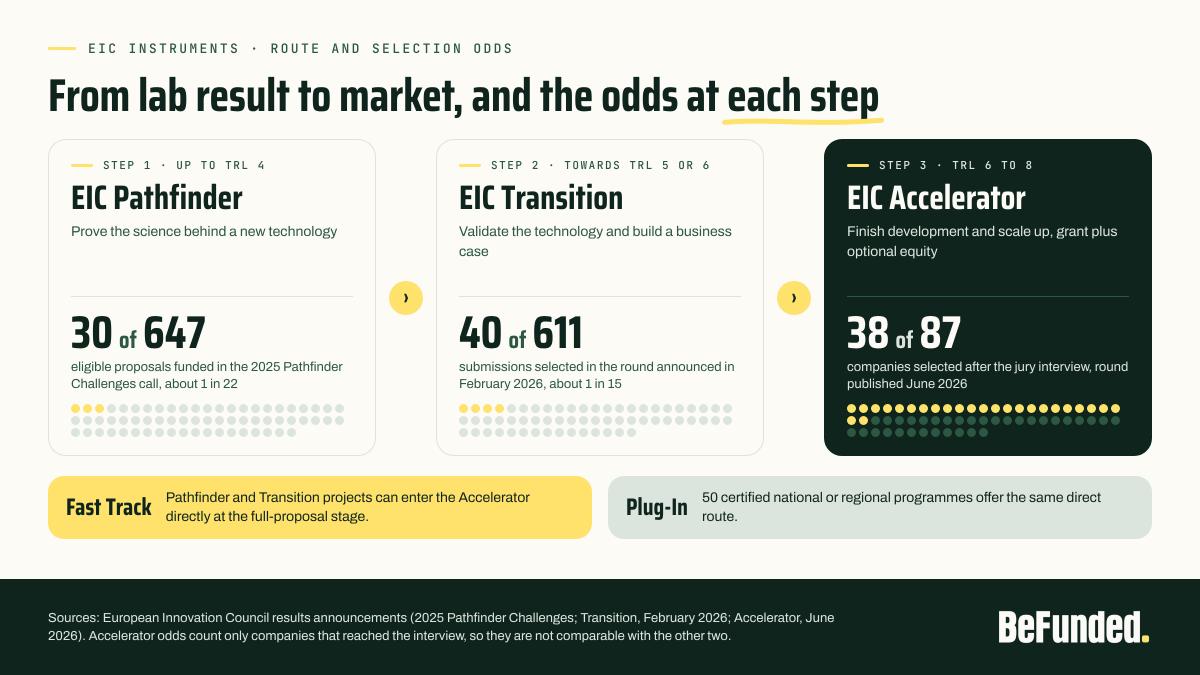
Italy offers a documented example. The chemistry department of the University of Bologna coordinated the Pathfinder project ECLipse. Its spin-off Bionys then won an EIC Transition grant for SEPtech, a technology for the early diagnosis of sepsis, as the university reported in February 2026.
Which EIC deadlines are still open in 2026?
For the three instruments in this guide, two 2026 deadlines remain open: Pathfinder Challenges on 28 October and the last Accelerator full-proposal cut-off on 4 November. EIC Transition closed on 16 September 2026 and Pathfinder Open on 12 May 2026.
| 2026 deadline | Status on 6 October 2026 | |
|---|---|---|
| EIC Pathfinder Open | 12 May 2026 | Closed |
| EIC Pathfinder Challenges | 28 October 2026 | Open |
| EIC Transition | 16 September 2026 | Closed |
| EIC Accelerator short proposal | Any time, batched on each month's first Tuesday | Open |
| EIC Accelerator full proposal | 4 November 2026 | Last 2026 cut-off |
Sources: EIC programme pages, checked 6 October 2026.
The EIC returns short-proposal results in 4 to 6 weeks. A short Accelerator proposal batched on 6 October 2026 therefore leaves no realistic time to file a full proposal by 4 November. Time your short proposal against the full-proposal date you actually want, using our guide to EIC Accelerator 2026 cut-off dates.
German applicants can get free, independent advice from the Nationale Kontaktstelle (NKS) EIC Accelerator, backed by the federal economics ministry, the Bundesministerium für Wirtschaft und Energie (BMWE). Its webinar on the 2027 work programme runs on 3 November 2026. For Pathfinder and Transition, the contact point sits at the EU office of the federal research ministry, the Bundesministerium für Forschung, Technologie und Raumfahrt (BMFTR).
Can you combine EIC funding with the Forschungszulage?
Yes, on the same R&D project, but never on the same costs. Section 7 of the Forschungszulagengesetz (FZulG), Germany's Research Allowance Act, lets the Forschungszulage run alongside other funding for the same project. Section 7(2) FZulG then keeps any cost already funded elsewhere out of the allowance base and states that this exclusion also covers EU funds.
| Allowed | Not allowed |
|---|---|
Claiming the allowance for own-funded R&D that runs next to an EIC-funded work package | Claiming the allowance for costs the EIC grant already covers |
Using the allowance for early development and an EIC grant for a later stage | Counting the same staff hours in both budgets |
Examples by Be-Funded, applying Section 7 FZulG.
In practice, keep one cost ledger that maps every euro either to an EIC work package or to own-funded R&D, and decide the split before you submit. Your Forschungszulage application must include the details needed to check this rule anyway; our research allowance consulting prepares it with you.
Our overview of EU funding programmes for companies covers more ways to combine EU grants with German instruments.
Which eligibility rules knock out EIC applications before evaluation?
Six eligibility rules end EIC applications before any evaluator reads the science, however strong the technology. They cover the consortium, the precursor result and its timing, the applicant type, the country of establishment and the one-application limit. Check all six before writing.
| Instrument | Pass condition | |
|---|---|---|
| Consortium | Pathfinder Open | At least 3 independent entities in 3 countries, 1 in an EU Member State |
| Precursor result | Transition | Results from an eligible EU project at TRL 3 completed or TRL 4 |
| Date window | Transition | Precursor project started more than 18 months before the cut-off, or ended within the last 24 months |
| Applicant type | Transition | No large company applying alone |
| Country | Pre-Accelerator | Company established in a widening country |
| One at a time | Accelerator | One live application; grant-only support once per company in Horizon Europe |
Sources: EIC programme pages and the UK National Contact Point for the EIC, checked 6 October 2026.
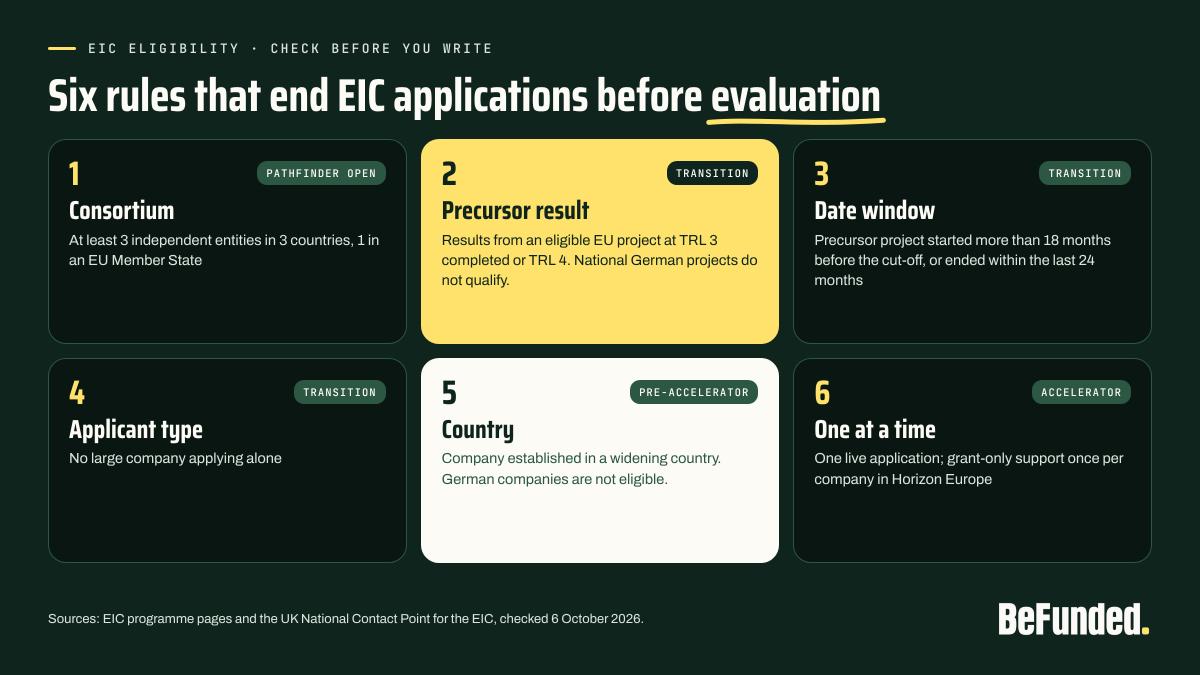
If your technology has completed TRL 5 and you are building alone rather than in a consortium, the EIC Accelerator is usually the instrument to aim for. Be-Funded's EIC Accelerator funding consulting starts with an honest fit check against the EIC criteria. It then covers the short proposal, the 20-page full proposal with its lump-sum budget, and rehearsal for the jury interview, which consultants cannot attend. The fee is agreed before work starts. If Pathfinder or Transition is the better route, we will tell you.
This article summarises EIC and German funding rules as published on 6 October 2026 and is not legal, tax or financial advice. Check the current call documents before you apply.
FAQ
EIC Pathfinder funds research consortia at TRL 1 to 4 with grants of up to EUR 4 million in 2026. The EIC Accelerator funds single start-ups and SMEs at TRL 6 to 8, with a grant below EUR 2.5 million plus optional equity of up to EUR 10 million.
An EIC Pathfinder grant pays up to EUR 4 million per project in 2026, more if duly justified, plus booster grants of up to EUR 50,000 to test commercial potential. The 2026 budgets are EUR 166 million for Pathfinder Open and EUR 96 million for Pathfinder Challenges.
No: EIC Transition only accepts proposals built on results from eligible EU-funded projects, such as EIC Pathfinder, ERC Proof of Concept or Horizon Europe Pillar II research actions. Those results must sit at TRL 3 completed or TRL 4, and proposals starting from any other level are ineligible.
Very: in the 2025 Pathfinder Challenges call, the EIC funded 30 of 647 eligible proposals, roughly 1 in 22, according to results published in April 2026. Pathfinder Open 2026 drew 2,103 proposals for a budget of EUR 166 million, so a clear breakthrough vision and a well-built consortium matter.

Related Posts
AgTech Funding in Europe: Which Grants Fit Your Stage in 2026 and 2027
Agtech funding is the money a company raises to develop agricultural technology, such as field robots, crop sensors, biologicals or farm software. In Europe, the public share comes from four sources: EU grants, German federal grants, the Forschungszulage tax credit, and promotional loans or public equity.
 Aydan Aliyeva 3 November 2026 · 14 min read
AI Grants in Europe: What AI Startups and SMEs Can Get in 2026 and 2027
AI grants are non-repayable public funding for a defined artificial intelligence project, either to build AI or to put it to work. For a startup or SME in Germany, five routes are realistic in late 2026: the EIC Accelerator, Horizon Europe AI calls, free EuroHPC compute, Digital Europe support and the Forschungszulage.
Aydan Aliyeva 2 November 2026 · 13 min read Energy Efficiency Grants in Germany: What Companies Can Get in 2026
Energy efficiency grants pay 10% to 60% of what a German company invests in efficient plant and processes. Here are the 2026 BAFA EEW rates by module and company size, the grant versus KfW loan choice, and the apply-first rule that decides whether you keep the money.
 Kirill Rubinstein 19 October 2026 · 12 min read